|
|
|
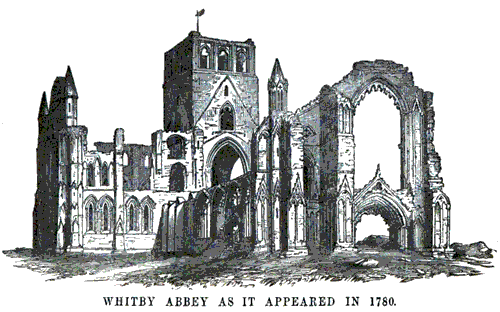

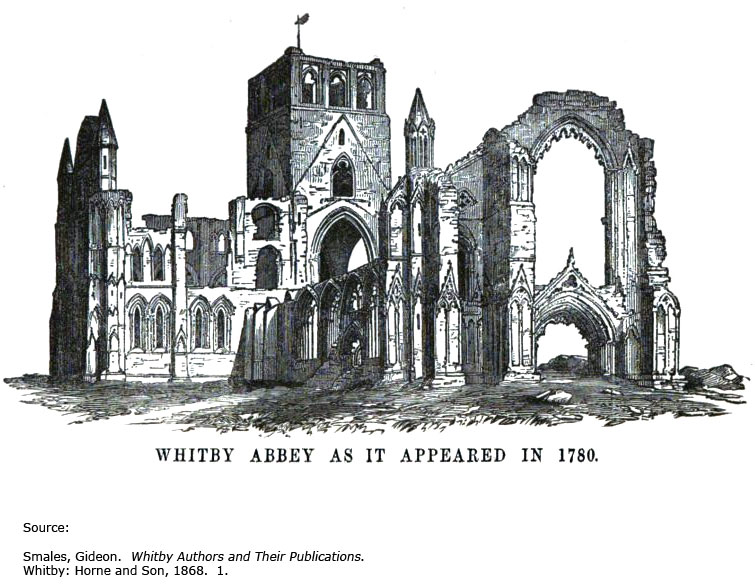
The dissolution or suppression of the monasteries in England was carried out during the reign
of King Henry VIII. It was a process started by
Thomas Wolsey and completed by Thomas Cromwell.
Ostensibly, the monasteries were eliminated due to prevalent corruption and indolence; in reality, it was to
secure the King's absolute power and to fill the dwindling royal coffers.
|
The Condition of the Monasteries on the Eve of their Dissolution.
— Having made himself supreme head of Church as well as State, Henry's next step was to secure resources to
maintain his absolutism, and by a judicious distribution of bribes to guard against a return of the old order.
A way was disovered in the dissolution of the monasteries, which offered the further attraction of crushing a class
which contained the most determined opponents of the royal policy. These were the real reasons for the step,
suggested, no doubt, by the resourceful Cromwell, who boasted that he would make his King
the richest prince in Christendom. On 21 January, 1535, he received a commission as Vicar-General and Viceregent to
hold a general visitation of all the churches and monastic and collegiate bodies in the realm.
The King and his supporters represented to Parliament that they were proceeding against the monasteries because of
the "slothful and ungodly lives" led by the inmates. This, however, was largely a pretext, and the charges brought
forward to support it were doubtless greatly exaggerated; moreover, the manner in which the work was carried out
cannot be justified. On the other hand, the condition of the monasteries was such as to lend at least a color of
justice to the movement against them. Formerly they had been the pioneers in husbandry, felling the forests, draining
the marshes, and cultivating the waste places, or, in the case of the Cistercians, in sheep raising. They had served
as inns for travelers, as depositories for articles of value; they had cared for the poor, and had fostered learning
and education. But they no longer filled the place which they had in the past. Their agricultural methods were antiquated,
and they no longer drew from the capital in their possession the returns which might be expected from efficient
management. Their method of promiscuous giving tended to nourish poverty rather than to check it, while their scholastic
and educational methods were quite out of date.
As their influence declined, the merchant and agricultural classes began more and more to hunger after their vast wealth.
All through the fifteenth century their numbers had fallen off steadily. From 1399 to 1509 only eight houses of religion
and seventy houses of learning and charity (i.e., colleges, schools, and hospitals) had been founded. Of twelve
hundred monasteries established since the introduction of Roman Catholicism into England hardly more than half had survived
into the reign of Henry VIII.
Further, religious orders had been subject to intermittent attacks on the part of the temporal power from a period as early
as the reign of Edward II, when twenty-three preceptories of the Knights Templars were destroyed.
The pious Henry V, as a blow against France, suppressed the alien priories. In 1506, when
Bishop Foxe of Winchester was thinking of making monastic endowments, a brother bishop declared
that "the monks have already more than they are like to keep," and Wolsey's dissolution of some
of the smaller monasteries followed not many years after. The extent of the monastic wealth was doubtless exaggerated.
According to some accounts the monks owned at least a quarter of the realm, but more sober and reliable estimates put it at
about one tenth.1
Cromwell's Monastic Visitors, 1535-1536.
— In July, 1535, visitors appointed by Cromwell began their rounds. Armed with articles of inquiry, they hurried from
house to house, asking all sorts of questions about revenues and debts, about relics, pilgrimages, superstitions, and
immoralities. They were an ambitious, greedy, and unscrupulous set, chiefly concerned with securing the sort of information
that would suit their purpose. The letters and reports or "comperts" which they sent to the Viceregent seem to have been based
upon the scantiest as well as the most partial investigation; for they feared to lose any time lest the monks might seize the
opportunity to dispose of their plate and jewels. By no means all the houses were visited; but enough to frame a case for the
Parliament.
Besides the articles of inquiry the visitors carried with them a series of injunctions which they were authorized to impose
upon the monasteries which they visited. Some were obviously designed to destroy the communities against which they should
be enforced. Monks were not only to accept, but to teach royal supremacy and repudiation of
papal claims; they were forbidden to leave their grounds and buildings, which made the management of their distant estates
impossible; and they were ordered to spy on and report their disobedient superiors, thus subverting all discipline. Some
of the injunctions, however, provided for salutary reforms. Victuals were not to be distributed to sturdy and idle beggars;
tables were to be "not over sumptuous, and full of delicate and strange dishes, but honestly furnished with common meats";
reading and study of the Scriptures was enjoined; and each house was to maintain a monk or two at the universities to better
prepare him to teach and preach the word of God.
The Act Suppressing the Smaller Monasteries, 1536.
— When Parliament met, 4 February, 1536, popular feeling in the City was inflamed by means of sermons, caricatures,
and pamphlets. Cranmer declared at Paul's Cross that the destruction of the monasteries would
relieve the people of a great burden of taxation. It is stated that "when the enormities were first read in Parliament House
they were so great and abominable that there was nothing but 'down with them'" and an act was carried suppressing all monastic
houses with an income under £200 a year or with less than twelve inmates.2 Commissions composed of local
gentry, appointed to wind up the affairs of the houses denounced by Cromwell's agents, testified to the fair character of many.
Nevertheless, aside from biased reports of the visitors and the charges in contemporary satires and ballads, the correspondence
of men high in the Church testifies that there was much need of reform. It might have been well, too, for economic reasons,
to suppress or consolidate the smaller and poorer houses, but it seems very strange to have drawn the line between virtue and
vice at £200 a year or at groups of twelve. There is a story that Henry resorted to great pressure to carry the measure,
that he summoned the Commons before him and announced that he would have the passage of the bill or some of their heads. In the
Upper House one speaker referring to the smaller houses said: "These were the thorns, but the great abbots were the petrified
old oaks and they must follow." This prophecy was soon realized.
In accordance with the Act some 376 monasteries were dissolved. A portion of their inmates went into larger houses, others were
provided with pensions. By paying large sums of money a few houses were allowed to continue for a time. As near as can be
estimated, about 2000 monks and nuns were dispossessed, and of servants, farm laborers, and others dependent upon them, perhaps
four times as many more were affected. Aside from lands and buildings, money, plate, and jewels, as well as the proceeds of the
sale of lead, bells, cattle, and furniture, passed into the King's hands. For dealing with all this property a special court
known as the Court of Augmentation was created. The smaller monasteries having been disposed of, Oxford and Cambridge were next
visited, measures were framed against the old learning, and others were adopted to encourage the study of Greek and Hebrew.
1. The total ecclesiastical revenue has been computed at £320,000; of this about £150,000
was monastic.
2. Besides the comperts, later writers speak of a famous "Black Book," containing the results of the visitors' findings, which
was laid before Parliament. According to the Protestant writers of Elizabeth's
reign it was destroyed during the Catholic reaction under Queen Mary, while historians of the
opposite party have insisted that it was disposed of earlier, because it contained charges that could not be substantiated.
There is no good evidence that such a book ever existed.
Source:
Cross, Arthur Lyon. A History of England and Greater Britain.
New York: The Macmillan Company, 1914. 322-324.
|
The dissolution of the smaller monasteries, combined with dissatisfaction over recent statutes governing
enclosures and uses, as well as outrage over the Ten Articles, all led to the uprisings known
as the Pilgrimage of Grace. After the Pilgrimage of Grace was brutally quelled, the King
used the uprising as a pretext for moving to suppress the larger religious houses as well.
|
The Dissolution of the Greater Monasteries
— The abbots in the disturbed districts were attainted of treason, and by a great stretch
of the law their houses were suppressed. The process, thus facilitated by the part which the monks took in the rising, went
on until not a single religious house remained in England.
Henry had no legal right to the larger monastic houses, especially those not involved in the rebellion. So he employed through
his agents the method of "voluntary surrender." Those heads who consented to yield were promised pensions and other rewards,
while such benefits were withheld from those who proved "wilful and obstinate." Thus, chiefly during the years 1538 and 1539,
some 150 monasteries and 50 convents of women were surrendered into the royal hands. During the autumn of 1538 and the
spring of the following year the English friars were destroyed.1
Parliament in 1539 dealt the final blow by passing an act vesting in Henry and his heirs all the monasteries which had already
or should surrender for the future. The abbots of Reading, Colchester, and Glastonbury were executed for pretended treason.
With the surrender of Waltham, 23 March, 1540, the last of the abbeys fell victim to the royal rapacity and the irresistible
assertion of supremacy, though the pretext that their inmates led "slothful and ungodly lives" was still insisted on.
* * *
The Results of the Dissolution of the Monasteries.
It has been estimated that over 8000 monks, canons, and friars were dispossessed, while at least ten times that number of
dependents were affected. The annual value of property secured seems to have been from £150,000 to £200,000. Of
this only about £45,000 was retained by the King, the rest was either appropriated for public purposes or given or sold
to royal supporters. The melting value of the gold and silver was probably about £85,000. Altogether, what with proceeds
of sales and annual revenues, the King secured, exclusive of vestments, ecclesiastical furniture, and jewels, close to
£1,500,000.*
Of the property thus acquired, some was given in pensions to the dispossessed monks, a very small proportion, however, of
what had been taken from them; some was devoted to the erection of six new bishoprics,2 and some was applied to
coast defenses. But the greater part went to certain favored nobles and gentry. In this way some of the best known of the
present English families — the Russells, Dukes of Bedford, and the Cavendishes, Dukes of Devonshire — started
on their upward road. The purpose of the King's seeming generosity was to ensure the permanence of the separation from Rome;
for men gorged with church plunder would never return to the fold.
Another result of the dissolution was to weaken the spiritual power of the House of Lords, since the bishops were no longer
reenforced by abbots and priors. Finally, the economic and social situation was profoundly affected. A further impulse to
enclosures was given, and the state was forced to give more attention than would have been immediately necessary to the
subjects of education and poor relief. Although the monasteries had outlived their usefulness and had ceased to make the
best use of their resources, the method employed by Henry and his agents to suppress them was marked by great cruelty and
injustice, and caused much suffering to innocent people.
1 The leading orders were: The Franciscans, the Dominicans, the Austins, and the
Carmelites. They had about 200 houses and 1800 members.
[*AJ Note: an amount equal to approximately £924,000,000 in purchasing power, compared to 2017, or nearly $1.25 billion.
Source: Measuring Worth]
2 Five of which exist today.
Source:
Cross, Arthur Lyon. A History of England and Greater Britain.
New York: The Macmillan Company, 1914. 328-330.
|
Other Local Resources:
Books for further study:
Moorhouse, Geoffrey. The Last Divine Office: Henry VIII and the Dissolution of the Monasteries
New York: BlueBridge, 2009.
Woodward, G.W.O. The Dissolution of the Monasteries. 2nd ed.
London: Pitkin Guides, 1993.
 | to Henry VIII |
| to Robert Aske |
| to Renaissance English Literature |
| to Luminarium Encyclopedia |
Site copyright ©1996-2023 Anniina Jokinen. All Rights Reserved.
Created by Anniina Jokinen on December 27, 2008. Last updated May 3, 2023.
|
Index of Encyclopedia Entries:
Medieval Cosmology
Prices of Items in Medieval England
Edward II
Isabella of France, Queen of England
Piers Gaveston
Thomas of Brotherton, E. of Norfolk
Edmund of Woodstock, E. of Kent
Thomas, Earl of Lancaster
Henry of Lancaster, Earl of Lancaster
Henry of Grosmont, Duke of Lancaster
Roger Mortimer, Earl of March
Hugh le Despenser the Younger
Bartholomew, Lord Burghersh, elder
Hundred Years' War (1337-1453)
Edward III
Philippa of Hainault, Queen of England
Edward, Black Prince of Wales
John of Eltham, Earl of Cornwall
The Battle of Crécy, 1346
The Siege of Calais, 1346-7
The Battle of Poitiers, 1356
Lionel of Antwerp, Duke of Clarence
John of Gaunt, Duke of Lancaster
Edmund of Langley, Duke of York
Thomas of Woodstock, Gloucester
Richard of York, E. of Cambridge
Richard Fitzalan, 3. Earl of Arundel
Roger Mortimer, 2nd Earl of March
The Good Parliament, 1376
Richard II
The Peasants' Revolt, 1381
Lords Appellant, 1388
Richard Fitzalan, 4. Earl of Arundel
Archbishop Thomas Arundel
Thomas de Beauchamp, E. Warwick
Robert de Vere, Earl of Oxford
Ralph Neville, E. of Westmorland
Thomas Mowbray, Duke of Norfolk
Edmund Mortimer, 3. Earl of March
Roger Mortimer, 4. Earl of March
John Holland, Duke of Exeter
Michael de la Pole, E. Suffolk
Hugh de Stafford, 2. E. Stafford
Henry IV
Edward, Duke of York
Edmund Mortimer, 5. Earl of March
Henry Percy, Earl of Northumberland
Sir Henry Percy, "Harry Hotspur"
Thomas Percy, Earl of Worcester
Owen Glendower
The Battle of Shrewsbury, 1403
Archbishop Richard Scrope
Thomas Mowbray, 3. E. Nottingham
John Mowbray, 2. Duke of Norfolk
Thomas Fitzalan, 5. Earl of Arundel
Henry V
Thomas, Duke of Clarence
John, Duke of Bedford
Humphrey, Duke of Gloucester
John Talbot, Earl of Shrewsbury
Richard, Earl of Cambridge
Henry, Baron Scrope of Masham
William de la Pole, Duke of Suffolk
Thomas Montacute, E. Salisbury
Richard Beauchamp, E. of Warwick
Henry Beauchamp, Duke of Warwick
Thomas Beaufort, Duke of Exeter
Cardinal Henry Beaufort
John Beaufort, Earl of Somerset
Sir John Fastolf
John Holland, 2. Duke of Exeter
Archbishop John Stafford
Archbishop John Kemp
Catherine of Valois
Owen Tudor
John Fitzalan, 7. Earl of Arundel
John, Lord Tiptoft
Charles VII, King of France
Joan of Arc
Louis XI, King of France
Charles the Bold, Duke of Burgundy
The Battle of Agincourt, 1415
The Battle of Castillon, 1453
The Wars of the Roses 1455-1485
Causes of the Wars of the Roses
The House of Lancaster
The House of York
The House of Beaufort
The House of Neville
The First Battle of St. Albans, 1455
The Battle of Blore Heath, 1459
The Rout of Ludford, 1459
The Battle of Northampton, 1460
The Battle of Wakefield, 1460
The Battle of Mortimer's Cross, 1461
The 2nd Battle of St. Albans, 1461
The Battle of Towton, 1461
The Battle of Hedgeley Moor, 1464
The Battle of Hexham, 1464
The Battle of Edgecote, 1469
The Battle of Losecoat Field, 1470
The Battle of Barnet, 1471
The Battle of Tewkesbury, 1471
The Treaty of Pecquigny, 1475
The Battle of Bosworth Field, 1485
The Battle of Stoke Field, 1487
Henry VI
Margaret of Anjou
Richard Plantagenet, Duke of York
Edward IV
Elizabeth Woodville
Richard Woodville, 1. Earl Rivers
Anthony Woodville, 2. Earl Rivers
Jane Shore
Edward V
Richard III
George, Duke of Clarence
Ralph Neville, 2. Earl of Westmorland
Richard Neville, Earl of Salisbury
Richard Neville, Earl of Warwick
Edward Neville, Baron Bergavenny
William Neville, Lord Fauconberg
Robert Neville, Bishop of Salisbury
John Neville, Marquis of Montagu
George Neville, Archbishop of York
John Beaufort, 1. Duke Somerset
Edmund Beaufort, 2. Duke Somerset
Henry Beaufort, 3. Duke of Somerset
Edmund Beaufort, 4. Duke Somerset
Margaret Beaufort
Edmund Tudor, Earl of Richmond
Jasper Tudor, Earl of Pembroke
Humphrey Stafford, D. Buckingham
Henry Stafford, Duke of Buckingham
Humphrey Stafford, E. of Devon
Thomas, Lord Stanley, Earl of Derby
Sir William Stanley
Archbishop Thomas Bourchier
Henry Bourchier, Earl of Essex
John Mowbray, 3. Duke of Norfolk
John Mowbray, 4. Duke of Norfolk
John Howard, Duke of Norfolk
Henry Percy, 2. E. Northumberland
Henry Percy, 3. E. Northumberland
Henry Percy, 4. E. Northumberland
William, Lord Hastings
Henry Holland, Duke of Exeter
William Fitzalan, Earl of Arundel
William Herbert, 1. Earl of Pembroke
John de Vere, 12th Earl of Oxford
John de Vere, 13th Earl of Oxford
Thomas de Clifford, 8. Baron Clifford
John de Clifford, 9. Baron Clifford
John Tiptoft, Earl of Worcester
Thomas Grey, 1. Marquis Dorset
Sir Andrew Trollop
Archbishop John Morton
Edward Plantagenet, E. of Warwick
John Talbot, 2. E. Shrewsbury
John Talbot, 3. E. Shrewsbury
John de la Pole, 2. Duke of Suffolk
John de la Pole, E. of Lincoln
Edmund de la Pole, E. of Suffolk
Richard de la Pole
John Sutton, Baron Dudley
James Butler, 5. Earl of Ormonde
Sir James Tyrell
Edmund Grey, first Earl of Kent
George Grey, 2nd Earl of Kent
John, 5th Baron Scrope of Bolton
James Touchet, 7th Baron Audley
Walter Blount, Lord Mountjoy
Robert Hungerford, Lord Moleyns
Thomas, Lord Scales
John, Lord Lovel and Holand
Francis Lovell, Viscount Lovell
Sir Richard Ratcliffe
William Catesby
Ralph, 4th Lord Cromwell
Jack Cade's Rebellion, 1450
Tudor Period
King Henry VII
Queen Elizabeth of York
Arthur, Prince of Wales
Lambert Simnel
Perkin Warbeck
The Battle of Blackheath, 1497
King Ferdinand II of Aragon
Queen Isabella of Castile
Maximilian I, Holy Roman Emperor
King Henry VIII
Queen Catherine of Aragon
Queen Anne Boleyn
Queen Jane Seymour
Queen Anne of Cleves
Queen Catherine Howard
Queen Katherine Parr
King Edward VI
Queen Mary I
Queen Elizabeth I
Henry Fitzroy, Duke of Richmond
Margaret Tudor, Queen of Scotland
James IV, King of Scotland
The Battle of Flodden Field, 1513
James V, King of Scotland
Mary of Guise, Queen of Scotland
Mary Tudor, Queen of France
Louis XII, King of France
Francis I, King of France
The Battle of the Spurs, 1513
Field of the Cloth of Gold, 1520
Charles V, Holy Roman Emperor
Eustace Chapuys, Imperial Ambassador
The Siege of Boulogne, 1544
Cardinal Thomas Wolsey
Archbishop Thomas Cranmer
Thomas Cromwell, Earl of Essex
Thomas, Lord Audley
Thomas Wriothesley, E. Southampton
Sir Richard Rich
Edward Stafford, D. of Buckingham
Thomas Howard, 2nd Duke of Norfolk
Thomas Howard, 3rd Duke of Norfolk
John Dudley, Duke of Northumberland
Charles Brandon, Duke of Suffolk
Thomas Boleyn, Earl of Wiltshire
George Boleyn, Viscount Rochford
John Russell, Earl of Bedford
Thomas Grey, 2. Marquis of Dorset
Henry Grey, D. of Suffolk
Charles Somerset, Earl of Worcester
George Talbot, 4. E. Shrewsbury
Francis Talbot, 5. E. Shrewsbury
Henry Algernon Percy,
5th Earl of Northumberland
Henry Algernon Percy,
6th Earl of Northumberland
Ralph Neville, 4. E. Westmorland
Henry Neville, 5. E. Westmorland
William Paulet, Marquis of Winchester
Sir Francis Bryan
Sir Nicholas Carew
John de Vere, 15th Earl of Oxford
John de Vere, 16th Earl of Oxford
Thomas Seymour, Lord Admiral
Edward Seymour, Protector Somerset
Margaret Pole, Countess of Salisbury
Henry Pole, Lord Montague
Sir Geoffrey Pole
Thomas Manners, Earl of Rutland
Henry Manners, Earl of Rutland
Henry Bourchier, 2. Earl of Essex
Robert Radcliffe, 1. Earl of Sussex
Henry Radcliffe, 2. Earl of Sussex
George Hastings, Earl of Huntingdon
Henry Courtenay, Marquis of Exeter
George Neville, Baron Bergavenny
Sir Edward Neville
William, Lord Paget
William Sandys, Baron Sandys
William Fitzwilliam, E. Southampton
Sir Anthony Browne
Sir Thomas Wriothesley
Sir William Kingston
George Brooke, Lord Cobham
Sir Richard Southwell
Thomas Fiennes, 9th Lord Dacre
Sir Francis Weston
Henry Norris
Lady Jane Grey
Sir Thomas Arundel
Sir Richard Sackville
Sir William Petre
Sir John Cheke
Walter Haddon, L.L.D
Sir Peter Carew
Sir John Mason
Nicholas Wotton
John Taylor
Sir Thomas Wyatt, the Younger
Cardinal Lorenzo Campeggio
Cardinal Reginald Pole
Stephen Gardiner, Bishop of Winchester
Edmund Bonner, Bishop of London
Nicholas Ridley, Bishop of London
John Hooper, Bishop of Gloucester
John Aylmer, Bishop of London
Thomas Linacre
William Grocyn
Archbishop William Warham
Cuthbert Tunstall, Bishop of Durham
Richard Fox, Bishop of Winchester
Edward Fox, Bishop of Hereford
Pope Julius II
Pope Leo X
Pope Clement VII
Pope Paul III
Pope Pius V
Pico della Mirandola
Desiderius Erasmus
Martin Bucer
Richard Pace
Christopher Saint-German
Thomas Tallis
Elizabeth Barton, the Nun of Kent
Hans Holbein, the Younger
The Sweating Sickness
Dissolution of the Monasteries
Pilgrimage of Grace, 1536
Robert Aske
Anne Askew
Lord Thomas Darcy
Sir Robert Constable
Oath of Supremacy
The Act of Supremacy, 1534
The First Act of Succession, 1534
The Third Act of Succession, 1544
The Ten Articles, 1536
The Six Articles, 1539
The Second Statute of Repeal, 1555
The Act of Supremacy, 1559
Articles Touching Preachers, 1583
Queen Elizabeth I
William Cecil, Lord Burghley
Robert Cecil, 1st Earl of Salisbury
Sir Francis Walsingham
Sir Nicholas Bacon
Sir Thomas Bromley
Robert Dudley, Earl of Leicester
Ambrose Dudley, Earl of Warwick
Henry Carey, Lord Hunsdon
Sir Thomas Egerton, Viscount Brackley
Sir Francis Knollys
Katherine "Kat" Ashley
Lettice Knollys, Countess of Leicester
George Talbot, 6. E. of Shrewsbury
Elizabeth, Countess of Shrewsbury
Gilbert Talbot, 7. E. of Shrewsbury
Sir Henry Sidney
Sir Robert Sidney
Archbishop Matthew Parker
Walter Devereux, 1st Earl of Essex
Robert Devereux, 2nd Earl of Essex
Penelope Devereux, Lady Rich
Sir Christopher Hatton
Edward Courtenay, E. Devonshire
Edward Manners, 3rd Earl of Rutland
Thomas Radcliffe, 3. Earl of Sussex
Henry Radcliffe, 4. Earl of Sussex
Robert Radcliffe, 5. Earl of Sussex
William Parr, Marquis of Northampton
Henry Wriothesley, 2. Southampton
Henry Wriothesley, 3. Southampton
Charles Neville, 6. E. Westmorland
Thomas Percy, 7. E. Northumberland
Henry Percy, 8. E. Northumberland
Henry Percy, 9. E. Nothumberland
William Herbert, 1. Earl of Pembroke
Charles, Lord Howard of Effingham
Thomas Howard, 4th Duke of Norfolk
Henry Howard, 1. Earl of Northampton
Thomas Howard, 1. Earl of Suffolk
Henry Hastings, 3. E. of Huntingdon
Edward Manners, 3rd Earl of Rutland
Roger Manners, 5th Earl of Rutland
Francis Manners, 6th Earl of Rutland
Henry FitzAlan, 12. Earl of Arundel
Thomas, Earl Arundell of Wardour
Edward Somerset, E. of Worcester
William Davison
Sir Walter Mildmay
Sir Ralph Sadler
Sir Amyas Paulet
Gilbert Gifford
Anthony Browne, Viscount Montague
François, Duke of Alençon & Anjou
Mary, Queen of Scots
Henry Stuart, Lord Darnley
James Hepburn, Earl of Bothwell
Anthony Babington and the Babington Plot
John Knox
Philip II of Spain
The Spanish Armada, 1588
Sir Francis Drake
Sir John Hawkins
William Camden
Archbishop Whitgift
Martin Marprelate Controversy
John Penry (Martin Marprelate)
Richard Bancroft, Archbishop of Canterbury
John Dee, Alchemist
Philip Henslowe
Edward Alleyn
The Blackfriars Theatre
The Fortune Theatre
The Rose Theatre
The Swan Theatre
Children's Companies
The Admiral's Men
The Lord Chamberlain's Men
Citizen Comedy
The Isle of Dogs, 1597
Common Law
Court of Common Pleas
Court of King's Bench
Court of Star Chamber
Council of the North
Fleet Prison
Assize
Attainder
First Fruits & Tenths
Livery and Maintenance
Oyer and terminer
Praemunire
The Stuarts
King James I of England
Anne of Denmark
Henry, Prince of Wales
The Gunpowder Plot, 1605
George Villiers, 1st Duke of Buckingham
Robert Carr, Earl of Somerset
Arabella Stuart, Lady Lennox
William Alabaster
Bishop Hall
Bishop Thomas Morton
Archbishop William Laud
John Selden
Lucy Harington, Countess of Bedford
Henry Lawes
King Charles I
Queen Henrietta Maria
Long Parliament
Rump Parliament
Kentish Petition, 1642
Thomas Wentworth, Earl of Strafford
John Digby, Earl of Bristol
George Digby, 2nd Earl of Bristol
Thomas Fairfax, 3rd Lord Fairfax
Robert Devereux, 3rd E. of Essex
Robert Sidney, 2. E. of Leicester
Algernon Percy, E. of Northumberland
Henry Montagu, Earl of Manchester
Edward Montagu, 2. Earl of Manchester
The Restoration
King Charles II
King James II
Test Acts
Greenwich Palace
Hatfield House
Richmond Palace
Windsor Palace
Woodstock Manor
The Cinque Ports
Mermaid Tavern
Malmsey Wine
Great Fire of London, 1666
Merchant Taylors' School
Westminster School
The Sanctuary at Westminster
"Sanctuary"
Images:
Chart of the English Succession from William I through Henry VII
Medieval English Drama
London c1480, MS Royal 16
London, 1510, the earliest view in print
Map of England from Saxton's Descriptio Angliae, 1579
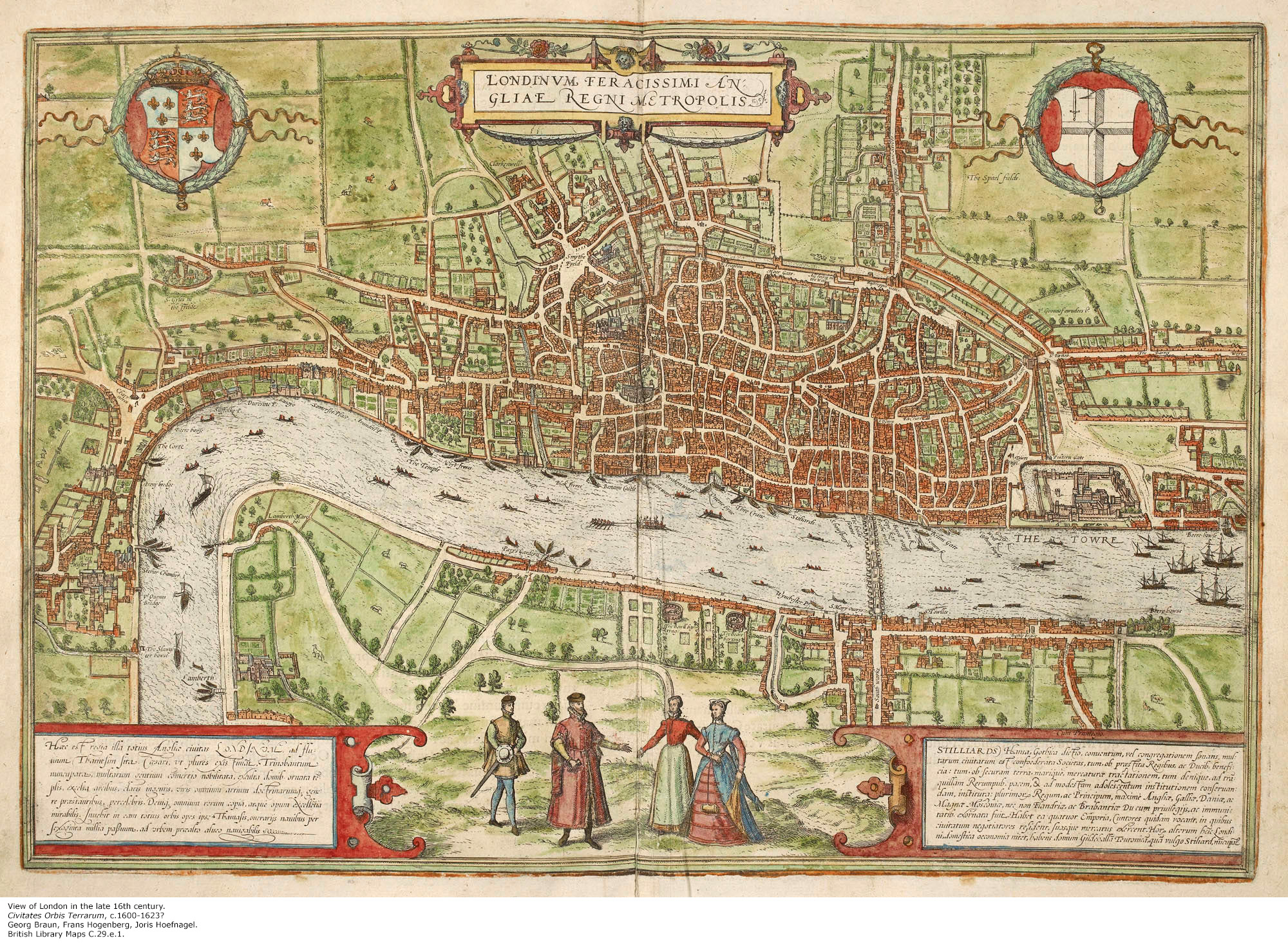
London in late 16th century
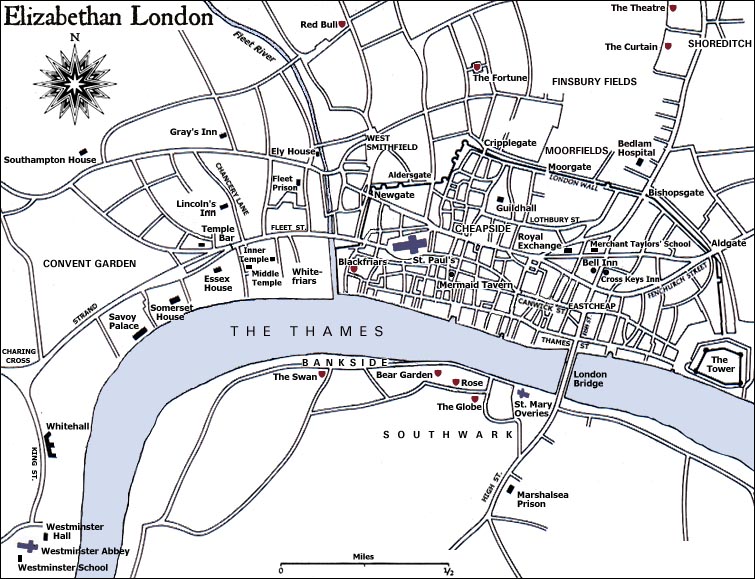
Location Map of Elizabethan London
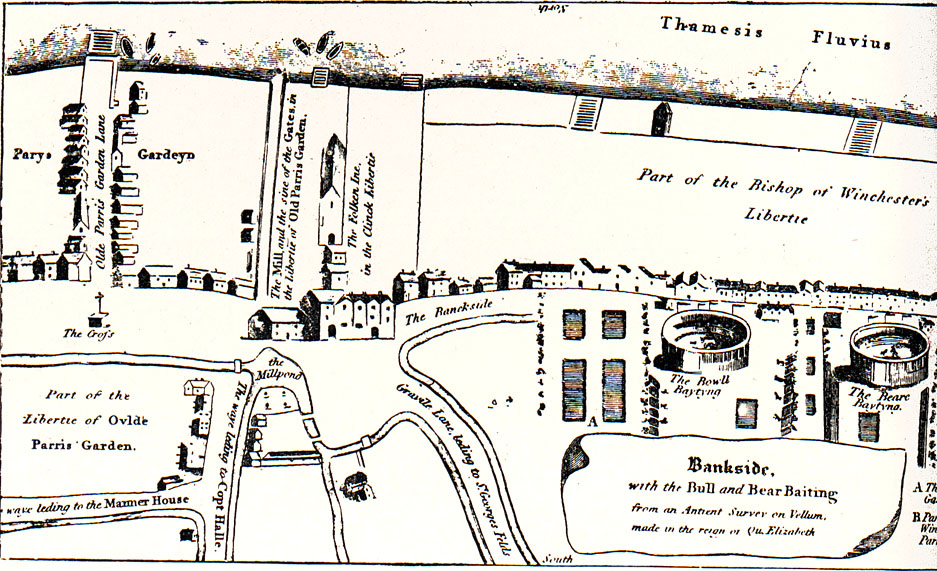
Plan of the Bankside, Southwark, in Shakespeare's time
Detail of Norden's Map of the Bankside, 1593
Bull and Bear Baiting Rings from the Agas Map (1569-1590, pub. 1631)
Sketch of the Swan Theatre, c. 1596
Westminster in the Seventeenth Century, by Hollar
Visscher's View of London, 1616
Larger Visscher's View in Sections
c. 1690. View of London Churches, after the Great Fire
The Yard of the Tabard Inn from Thornbury, Old and New London
|
|