|
|
|
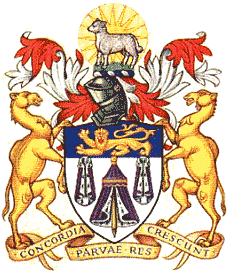
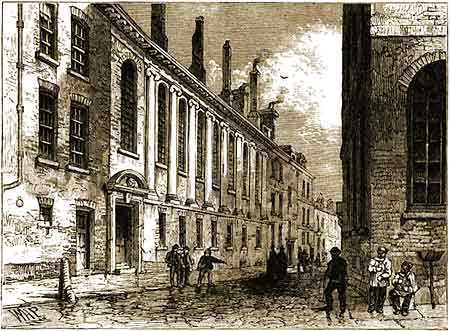
MERCHANT TAYLORS' SCHOOL was founded in 1561 by the Merchant Taylors' Company of London, a guild of tailors and linen-armourers.
Its first headmaster was the famous schoolmaster Richard Mulcaster. The school still educates young minds today.
Famous past students of the school include Edmund Spenser, Thomas Kyd, Lancelot Andrewes, John Webster, and James Shirley.
|
The following is W. Carew Hazlitt's description of the history of Merchant Taylors' School, which he attended 1842-1850.
Excerpted from:
Hazlitt, W. Carew. Schools, School-books, and Schoolmasters.
London: J. W. Jarvis & Son, 1888. 136-145.
The origin of Merchant Taylor's School is thus described by Wilson:—
"Towards the close of the year 1560, or early in the following spring, the Merchant Taylors' Company
conceived the laudable design of founding a grammar school; and and part of the manor of the Rose, in the parish of St. Lawrence-Pountney
(a mansion which had successively belonged to the Duke of Buckingham, the Marquis of Exeter, and the Earls of Sussex), seeming eligible
for the purpose, Mr. Richard Hills, a leading member of the court, generously contributed the sum of five hundred pounds towards the
purchase of it; but the institution was not thoroughly organised till the 24th September 1561, on which day the statutes were framed
and a schoolmaster chosen."
With the statutes I have no farther concern than with the clause which directs that the two hundred and fifty scholars, to which the
school was limited, were "to be taught in manner & forme as is afore devised & appointed. But first see that they can the catechisme
in English or Latyn, & that ever of the said two hundred & fifty schollers can read perfectly & write competently, or els lett them
not be admitted in no wise."
It is rather curious that the hours of attendance were originally from seven till eleven A.M. and from one till
five P.M., and that in winter the boys were to bring no candles of tallow, but candles of wax. This was following
the statutes of Dean Colet. Thrice in the day there were prayers; but instead of one of the sixth form saying them for the rest, as
was subsequently customary, each boy seems at first to have prayed for himself. The printed form usually employed was brief enough,
and not, like the Manual prepared by Bishop Ken for Winchester, adapted for the use of "all other devout Christians."
The staff consisted at the outset of a headmaster and three ushers, whose united emoluments were forty pounds a year, and the first
chief teacher of the school was Richard Mulcaster. It appears that the earliest Probation Day, as it was termed, was in November 1564,
when Dean Nowell and others examined the ushers and the boys with a very gratifying result. These appositions were renewed in 1565,
and probably still continue from year to year. They commenced in 1564 at eight o'clock in the morning, and so they did in my time
[1842-1850]. The practice of visitation by the Court on this day seems to have ceased in 1606.
Alderman Sir Thomas White, some time subsequently to the foundation of the school by the Company, augmented the endowment, so as to
enable the institution to develop itself, and enlarge its sphere of utility in connection with Oxford University and in other ways.
White was a member of the Court when the scheme was adopted, but he was not, strictly speaking, as he has been usually termed and
considered, the founder of Merchant Taylors'.
We do not arrive, meanwhile, at any clear or complete notion of the books which were used at the school, but it is to be inferred
that Lily's Grammar was the Latin text-book. In the rules made for Probation-Day in 1606-7, I find Æsop's Fables in
Greek, Tully's Epistles, and the Dialogues of Corderius named as works in which the boys were to be tested. The
subjects taken on this day were Greek, Latin, and dictation, writing being necessarily included. Neither Hebrew, nor arithmetic,
nor the mathematics are enumerated; there are the six forms, but no monitors or prompters.
The School's Probation presents itself for the first time as a printed production, or at least as something compiled in book
form, under the date of 1608. It is printed entire by Wilson; but he does not state, nor do I know, what original, whether printed
or not, he employed.
Probation-Day still continued in my time to be an important event—a sort of red-letter day in our calendar. The hour for
assembling was eight o'clock, instead of nine; it had been half-past six while the school was exclusively composed of residents
within a limited radius; but the enlarged time was a sore trial in the winter where one had to travel from a suburb, as I did
from Old Brompton. They supplied breakfast at the place, not gratuitously, but at a fixed tariff. It would not have been much
for a wealthy Company to provide an entertainment once or twice a year for two or three hundred lads at a shilling or so a head;
but the Merchant Taylors, I think, have always been notorious for parsimony. Very little was accomplished before the meal, and
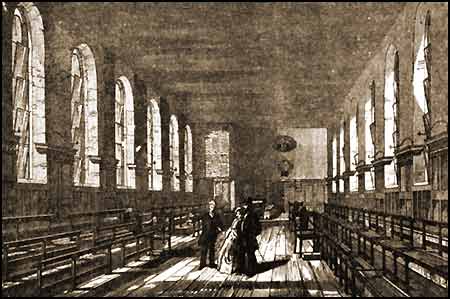
after its completion we had to set to work, the old room upstairs being as ill-adapted for the purpose of an examination as can
well be imagined, the boys having to use the forms as desks and to kneel in front of them. We were a very short distance from
the Middle Ages. Matters were not much changed since the time of the original establishment of the charity. Indeed, it appears
from Dugard's School's Probation, 1652, that in the seventeenth century the Company paid for some kind of collation:—
"There shall be paid unto the Master of the School, for beer, ale, and new manchet-bread, with a
dish of sweet butter, which hee shall have ready in the morning, with two fine glasses set upon the Table, and covered with two
fair napkins, and two fine trenchers, with a knife laid upon each trencher, to the end that such as please may take part, to
staie their stomachs until the end of the examination. . . ijs."
The number of boys was in 1652 comparatively limited; but of course without a revival of the ancient miracle two shillings' worth
of victuals would not have gone far in allaying the hunger of a far smaller gathering, and this allowance must have simply been
for such as had missed their meal at home, or desired additional refreshment.
The old examination itself presents numerous points of curiosity, as we look at it through the present medium. Considerable stress
seems to have been laid on dictation. The master opened, on the sudden, Cicero, the Greek Testament, Æsop's Fables in
Greek, and read a passage, which the boys of a particular form had to take down, and then turn into some other language, or into
verse, or make verses upon it—a pretty piece of trifling, much like the nonsense-verses which we used to have to compose in
my day, and as profitable.
Some of the English sentences to be turned into Latin are odd enough: "Bacchus and Apollo send for Homer;" "I went to Colchester
to eat oysters;" "My uncle went to Oxford to buie gloves;" "The Atheist went to Amsterdam to chuse his religion." Others might
have been autobiographical: "Marie was my sister, she dwelt at London;" "Elisabeth was my Aunt, she dwelt at York;" "Anna was my
Grandmother, she dwelt at Worcester."
In another place, under Sententiæ Varietas, there are five-and-twenty ways of describing in a sentence the great
qualities of Cicero.
Greek was certainly studied with a good deal of attention here in the early time, judging from the space which is devoted to it in
the scheme of Dugard, in whose small volume the questions and theses in that language occupy twenty pages. Erasmus
had, doubtless, had a large share in popularising among us the cultivation of Hellenic grammar and letters.
Even when the present writer was at the school, Hebrew was by no means assiduously or scientifically followed, nor do I believe
that on the staff of masters there was any one who properly understood the language. But it was part of the programme, and the late
Sir Moses Montefiore, who usually attended on Speech and Prize Day, was the annual donor of a Hebrew medal.
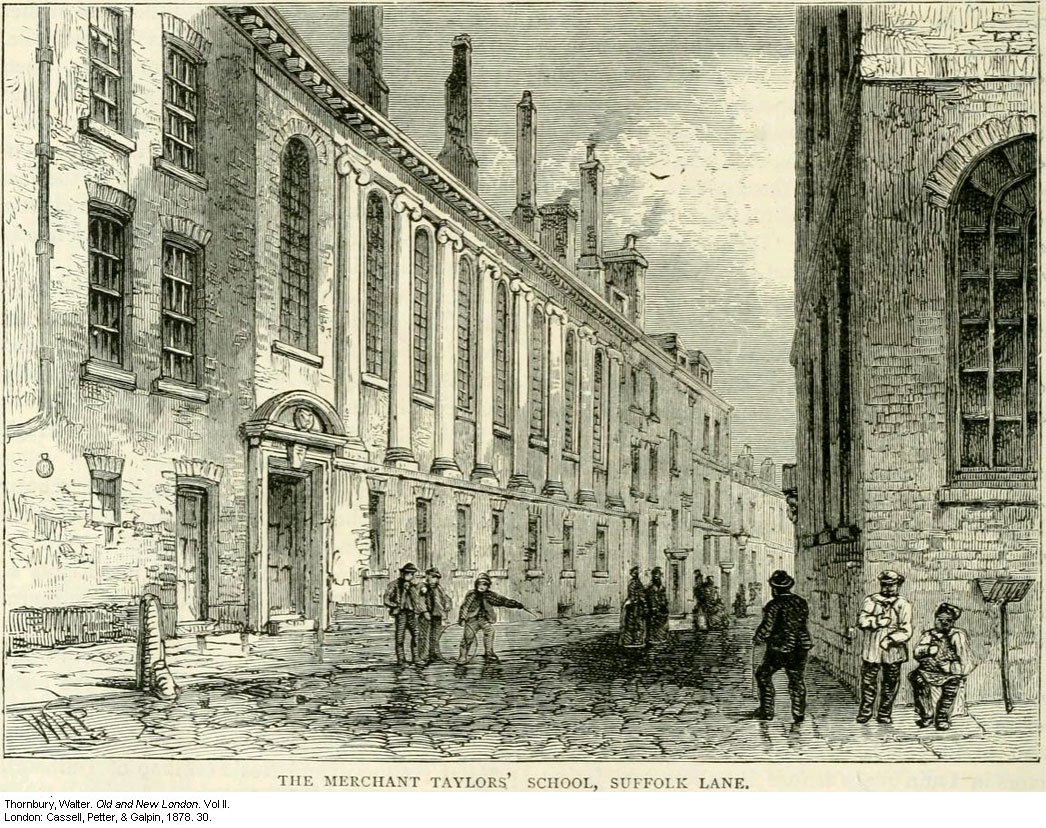
Speech-Day at Merchant Taylor's was the sole occasion on which the large schoolroom in Suffolk Lane was ever honoured by the presence
of the fair sex. The lower end of the room was converted into an extempore stage, and the monitors and prompters took part in some
recitation, or select scene from the Latin or Greek dramatists. At a later period French themes were introduced.
As far back as the reign of Charles I, the large contribution which the ladies and other friends of the
scholars made to the audience, and their imperfect acquaintance with the dead languages, rendered it a subject of regret and complaint
that the entertainment was not given in the vernacular, and the writer of a small volume called Ludus Ludi Litterarii, 1672,
purporting to report a series of speeches delivered at various breakings-up, states that the majority of them were in English on this
very account. As early as the time of Henry VIII, the practice of exhibiting
some dramatic performance at the close of the term, and usually at Christmas, was in vogue; but these spectacles were, it is to be
suspected, almost uniformly in the original language of the classic author, or in the scholastic Latin of the period.
A feeling in favour of a reform in these arrangements had, as has been mentioned, arisen when Hawkins wrote for the free school at
Hadleigh in Suffolk his play entitled Apollo Shroving, 1627, where one of the characters desires the Prologue to speak what
he has to say in honest English, for all their sakes, and describes the predilection for employing Latin as more appropriate to the
University.
Occasionally, instead of plays, there were musical entertainments; and the custom of signalling the termination of the school-work
seems to have been followed by the private academies.
But the antipathy to change and the temptation to a display of erudition have always proved too strong an obstacle to improvement;
and when the writer was last present at this anniversary, the ancient precedent was still in force, and the Court of the Merchant
Taylors and general company listened in respectful silence to interlocutions or monologues as mysterious to them as the Writing on
the Wall.
Hazlitt, W. Carew. Schools, School-books, and Schoolmasters.
London: J. W. Jarvis & Son, 1888. 136-145.
Other Local Resources:
Books for further study:
Draper, F. W. M. Four Centuries of Merchant Taylors' School 1561-1961.
Oxford University Press, 1962.
Watson, Foster. The Old Grammar Schools.
RoutledgeFalmer, 1968.
Wilson, Harry Bristow. The History of Merchant-Taylors' School.
London: 1812.
Merchant Taylors' School on the Web:
 | to Richard III |
| to Henry VII |
| to Elizabeth of York |
| to Renaissance English Literature |
| to Luminarium Encyclopedia |
Site ©1996-2023 Anniina Jokinen. All rights reserved.
This page was created on April 12, 2007. Last updated February 25, 2023.
|
Index of Encyclopedia Entries:
Medieval Cosmology
Prices of Items in Medieval England
Edward II
Isabella of France, Queen of England
Piers Gaveston
Thomas of Brotherton, E. of Norfolk
Edmund of Woodstock, E. of Kent
Thomas, Earl of Lancaster
Henry of Lancaster, Earl of Lancaster
Henry of Grosmont, Duke of Lancaster
Roger Mortimer, Earl of March
Hugh le Despenser the Younger
Bartholomew, Lord Burghersh, elder
Hundred Years' War (1337-1453)
Edward III
Philippa of Hainault, Queen of England
Edward, Black Prince of Wales
John of Eltham, Earl of Cornwall
The Battle of Crécy, 1346
The Siege of Calais, 1346-7
The Battle of Poitiers, 1356
Lionel of Antwerp, Duke of Clarence
John of Gaunt, Duke of Lancaster
Edmund of Langley, Duke of York
Thomas of Woodstock, Gloucester
Richard of York, E. of Cambridge
Richard Fitzalan, 3. Earl of Arundel
Roger Mortimer, 2nd Earl of March
The Good Parliament, 1376
Richard II
The Peasants' Revolt, 1381
Lords Appellant, 1388
Richard Fitzalan, 4. Earl of Arundel
Archbishop Thomas Arundel
Thomas de Beauchamp, E. Warwick
Robert de Vere, Earl of Oxford
Ralph Neville, E. of Westmorland
Thomas Mowbray, Duke of Norfolk
Edmund Mortimer, 3. Earl of March
Roger Mortimer, 4. Earl of March
John Holland, Duke of Exeter
Michael de la Pole, E. Suffolk
Hugh de Stafford, 2. E. Stafford
Henry IV
Edward, Duke of York
Edmund Mortimer, 5. Earl of March
Henry Percy, Earl of Northumberland
Sir Henry Percy, "Harry Hotspur"
Thomas Percy, Earl of Worcester
Owen Glendower
The Battle of Shrewsbury, 1403
Archbishop Richard Scrope
Thomas Mowbray, 3. E. Nottingham
John Mowbray, 2. Duke of Norfolk
Thomas Fitzalan, 5. Earl of Arundel
Henry V
Thomas, Duke of Clarence
John, Duke of Bedford
Humphrey, Duke of Gloucester
John Talbot, Earl of Shrewsbury
Richard, Earl of Cambridge
Henry, Baron Scrope of Masham
William de la Pole, Duke of Suffolk
Thomas Montacute, E. Salisbury
Richard Beauchamp, E. of Warwick
Henry Beauchamp, Duke of Warwick
Thomas Beaufort, Duke of Exeter
Cardinal Henry Beaufort
John Beaufort, Earl of Somerset
Sir John Fastolf
John Holland, 2. Duke of Exeter
Archbishop John Stafford
Archbishop John Kemp
Catherine of Valois
Owen Tudor
John Fitzalan, 7. Earl of Arundel
John, Lord Tiptoft
Charles VII, King of France
Joan of Arc
Louis XI, King of France
Charles the Bold, Duke of Burgundy
The Battle of Agincourt, 1415
The Battle of Castillon, 1453
The Wars of the Roses 1455-1485
Causes of the Wars of the Roses
The House of Lancaster
The House of York
The House of Beaufort
The House of Neville
The First Battle of St. Albans, 1455
The Battle of Blore Heath, 1459
The Rout of Ludford, 1459
The Battle of Northampton, 1460
The Battle of Wakefield, 1460
The Battle of Mortimer's Cross, 1461
The 2nd Battle of St. Albans, 1461
The Battle of Towton, 1461
The Battle of Hedgeley Moor, 1464
The Battle of Hexham, 1464
The Battle of Edgecote, 1469
The Battle of Losecoat Field, 1470
The Battle of Barnet, 1471
The Battle of Tewkesbury, 1471
The Treaty of Pecquigny, 1475
The Battle of Bosworth Field, 1485
The Battle of Stoke Field, 1487
Henry VI
Margaret of Anjou
Richard Plantagenet, Duke of York
Edward IV
Elizabeth Woodville
Richard Woodville, 1. Earl Rivers
Anthony Woodville, 2. Earl Rivers
Jane Shore
Edward V
Richard III
George, Duke of Clarence
Ralph Neville, 2. Earl of Westmorland
Richard Neville, Earl of Salisbury
Richard Neville, Earl of Warwick
Edward Neville, Baron Bergavenny
William Neville, Lord Fauconberg
Robert Neville, Bishop of Salisbury
John Neville, Marquis of Montagu
George Neville, Archbishop of York
John Beaufort, 1. Duke Somerset
Edmund Beaufort, 2. Duke Somerset
Henry Beaufort, 3. Duke of Somerset
Edmund Beaufort, 4. Duke Somerset
Margaret Beaufort
Edmund Tudor, Earl of Richmond
Jasper Tudor, Earl of Pembroke
Humphrey Stafford, D. Buckingham
Henry Stafford, Duke of Buckingham
Humphrey Stafford, E. of Devon
Thomas, Lord Stanley, Earl of Derby
Sir William Stanley
Archbishop Thomas Bourchier
Henry Bourchier, Earl of Essex
John Mowbray, 3. Duke of Norfolk
John Mowbray, 4. Duke of Norfolk
John Howard, Duke of Norfolk
Henry Percy, 2. E. Northumberland
Henry Percy, 3. E. Northumberland
Henry Percy, 4. E. Northumberland
William, Lord Hastings
Henry Holland, Duke of Exeter
William Fitzalan, Earl of Arundel
William Herbert, 1. Earl of Pembroke
John de Vere, 12th Earl of Oxford
John de Vere, 13th Earl of Oxford
Thomas de Clifford, 8. Baron Clifford
John de Clifford, 9. Baron Clifford
John Tiptoft, Earl of Worcester
Thomas Grey, 1. Marquis Dorset
Sir Andrew Trollop
Archbishop John Morton
Edward Plantagenet, E. of Warwick
John Talbot, 2. E. Shrewsbury
John Talbot, 3. E. Shrewsbury
John de la Pole, 2. Duke of Suffolk
John de la Pole, E. of Lincoln
Edmund de la Pole, E. of Suffolk
Richard de la Pole
John Sutton, Baron Dudley
James Butler, 5. Earl of Ormonde
Sir James Tyrell
Edmund Grey, first Earl of Kent
George Grey, 2nd Earl of Kent
John, 5th Baron Scrope of Bolton
James Touchet, 7th Baron Audley
Walter Blount, Lord Mountjoy
Robert Hungerford, Lord Moleyns
Thomas, Lord Scales
John, Lord Lovel and Holand
Francis Lovell, Viscount Lovell
Sir Richard Ratcliffe
William Catesby
Ralph, 4th Lord Cromwell
Jack Cade's Rebellion, 1450
Tudor Period
King Henry VII
Queen Elizabeth of York
Arthur, Prince of Wales
Lambert Simnel
Perkin Warbeck
The Battle of Blackheath, 1497
King Ferdinand II of Aragon
Queen Isabella of Castile
Maximilian I, Holy Roman Emperor
King Henry VIII
Queen Catherine of Aragon
Queen Anne Boleyn
Queen Jane Seymour
Queen Anne of Cleves
Queen Catherine Howard
Queen Katherine Parr
King Edward VI
Queen Mary I
Queen Elizabeth I
Henry Fitzroy, Duke of Richmond
Margaret Tudor, Queen of Scotland
James IV, King of Scotland
The Battle of Flodden Field, 1513
James V, King of Scotland
Mary of Guise, Queen of Scotland
Mary Tudor, Queen of France
Louis XII, King of France
Francis I, King of France
The Battle of the Spurs, 1513
Field of the Cloth of Gold, 1520
Charles V, Holy Roman Emperor
Eustace Chapuys, Imperial Ambassador
The Siege of Boulogne, 1544
Cardinal Thomas Wolsey
Archbishop Thomas Cranmer
Thomas Cromwell, Earl of Essex
Thomas, Lord Audley
Thomas Wriothesley, E. Southampton
Sir Richard Rich
Edward Stafford, D. of Buckingham
Thomas Howard, 2nd Duke of Norfolk
Thomas Howard, 3rd Duke of Norfolk
John Dudley, Duke of Northumberland
Charles Brandon, Duke of Suffolk
Thomas Boleyn, Earl of Wiltshire
George Boleyn, Viscount Rochford
John Russell, Earl of Bedford
Thomas Grey, 2. Marquis of Dorset
Henry Grey, D. of Suffolk
Charles Somerset, Earl of Worcester
George Talbot, 4. E. Shrewsbury
Francis Talbot, 5. E. Shrewsbury
Henry Algernon Percy,
5th Earl of Northumberland
Henry Algernon Percy,
6th Earl of Northumberland
Ralph Neville, 4. E. Westmorland
Henry Neville, 5. E. Westmorland
William Paulet, Marquis of Winchester
Sir Francis Bryan
Sir Nicholas Carew
John de Vere, 15th Earl of Oxford
John de Vere, 16th Earl of Oxford
Thomas Seymour, Lord Admiral
Edward Seymour, Protector Somerset
Margaret Pole, Countess of Salisbury
Henry Pole, Lord Montague
Sir Geoffrey Pole
Thomas Manners, Earl of Rutland
Henry Manners, Earl of Rutland
Henry Bourchier, 2. Earl of Essex
Robert Radcliffe, 1. Earl of Sussex
Henry Radcliffe, 2. Earl of Sussex
George Hastings, Earl of Huntingdon
Henry Courtenay, Marquis of Exeter
George Neville, Baron Bergavenny
Sir Edward Neville
William, Lord Paget
William Sandys, Baron Sandys
William Fitzwilliam, E. Southampton
Sir Anthony Browne
Sir Thomas Wriothesley
Sir William Kingston
George Brooke, Lord Cobham
Sir Richard Southwell
Thomas Fiennes, 9th Lord Dacre
Sir Francis Weston
Henry Norris
Lady Jane Grey
Sir Thomas Arundel
Sir Richard Sackville
Sir William Petre
Sir John Cheke
Walter Haddon, L.L.D
Sir Peter Carew
Sir John Mason
Nicholas Wotton
John Taylor
Sir Thomas Wyatt, the Younger
Cardinal Lorenzo Campeggio
Cardinal Reginald Pole
Stephen Gardiner, Bishop of Winchester
Edmund Bonner, Bishop of London
Nicholas Ridley, Bishop of London
John Hooper, Bishop of Gloucester
John Aylmer, Bishop of London
Thomas Linacre
William Grocyn
Archbishop William Warham
Cuthbert Tunstall, Bishop of Durham
Richard Fox, Bishop of Winchester
Edward Fox, Bishop of Hereford
Pope Julius II
Pope Leo X
Pope Clement VII
Pope Paul III
Pope Pius V
Pico della Mirandola
Desiderius Erasmus
Martin Bucer
Richard Pace
Christopher Saint-German
Thomas Tallis
Elizabeth Barton, the Nun of Kent
Hans Holbein, the Younger
The Sweating Sickness
Dissolution of the Monasteries
Pilgrimage of Grace, 1536
Robert Aske
Anne Askew
Lord Thomas Darcy
Sir Robert Constable
Oath of Supremacy
The Act of Supremacy, 1534
The First Act of Succession, 1534
The Third Act of Succession, 1544
The Ten Articles, 1536
The Six Articles, 1539
The Second Statute of Repeal, 1555
The Act of Supremacy, 1559
Articles Touching Preachers, 1583
Queen Elizabeth I
William Cecil, Lord Burghley
Robert Cecil, 1st Earl of Salisbury
Sir Francis Walsingham
Sir Nicholas Bacon
Sir Thomas Bromley
Robert Dudley, Earl of Leicester
Ambrose Dudley, Earl of Warwick
Henry Carey, Lord Hunsdon
Sir Thomas Egerton, Viscount Brackley
Sir Francis Knollys
Katherine "Kat" Ashley
Lettice Knollys, Countess of Leicester
George Talbot, 6. E. of Shrewsbury
Elizabeth, Countess of Shrewsbury
Gilbert Talbot, 7. E. of Shrewsbury
Sir Henry Sidney
Sir Robert Sidney
Archbishop Matthew Parker
Walter Devereux, 1st Earl of Essex
Robert Devereux, 2nd Earl of Essex
Penelope Devereux, Lady Rich
Sir Christopher Hatton
Edward Courtenay, E. Devonshire
Edward Manners, 3rd Earl of Rutland
Thomas Radcliffe, 3. Earl of Sussex
Henry Radcliffe, 4. Earl of Sussex
Robert Radcliffe, 5. Earl of Sussex
William Parr, Marquis of Northampton
Henry Wriothesley, 2. Southampton
Henry Wriothesley, 3. Southampton
Charles Neville, 6. E. Westmorland
Thomas Percy, 7. E. Northumberland
Henry Percy, 8. E. Northumberland
Henry Percy, 9. E. Nothumberland
William Herbert, 1. Earl of Pembroke
Charles, Lord Howard of Effingham
Thomas Howard, 4th Duke of Norfolk
Henry Howard, 1. Earl of Northampton
Thomas Howard, 1. Earl of Suffolk
Henry Hastings, 3. E. of Huntingdon
Edward Manners, 3rd Earl of Rutland
Roger Manners, 5th Earl of Rutland
Francis Manners, 6th Earl of Rutland
Henry FitzAlan, 12. Earl of Arundel
Thomas, Earl Arundell of Wardour
Edward Somerset, E. of Worcester
William Davison
Sir Walter Mildmay
Sir Ralph Sadler
Sir Amyas Paulet
Gilbert Gifford
Anthony Browne, Viscount Montague
François, Duke of Alençon & Anjou
Mary, Queen of Scots
Henry Stuart, Lord Darnley
James Hepburn, Earl of Bothwell
Anthony Babington and the Babington Plot
John Knox
Philip II of Spain
The Spanish Armada, 1588
Sir Francis Drake
Sir John Hawkins
William Camden
Archbishop Whitgift
Martin Marprelate Controversy
John Penry (Martin Marprelate)
Richard Bancroft, Archbishop of Canterbury
John Dee, Alchemist
Philip Henslowe
Edward Alleyn
The Blackfriars Theatre
The Fortune Theatre
The Rose Theatre
The Swan Theatre
Children's Companies
The Admiral's Men
The Lord Chamberlain's Men
Citizen Comedy
The Isle of Dogs, 1597
Common Law
Court of Common Pleas
Court of King's Bench
Court of Star Chamber
Council of the North
Fleet Prison
Assize
Attainder
First Fruits & Tenths
Livery and Maintenance
Oyer and terminer
Praemunire
The Stuarts
King James I of England
Anne of Denmark
Henry, Prince of Wales
The Gunpowder Plot, 1605
George Villiers, 1st Duke of Buckingham
Robert Carr, Earl of Somerset
Arabella Stuart, Lady Lennox
William Alabaster
Bishop Hall
Bishop Thomas Morton
Archbishop William Laud
John Selden
Lucy Harington, Countess of Bedford
Henry Lawes
King Charles I
Queen Henrietta Maria
Long Parliament
Rump Parliament
Kentish Petition, 1642
Thomas Wentworth, Earl of Strafford
John Digby, Earl of Bristol
George Digby, 2nd Earl of Bristol
Thomas Fairfax, 3rd Lord Fairfax
Robert Devereux, 3rd E. of Essex
Robert Sidney, 2. E. of Leicester
Algernon Percy, E. of Northumberland
Henry Montagu, Earl of Manchester
Edward Montagu, 2. Earl of Manchester
The Restoration
King Charles II
King James II
Test Acts
Greenwich Palace
Hatfield House
Richmond Palace
Windsor Palace
Woodstock Manor
The Cinque Ports
Mermaid Tavern
Malmsey Wine
Great Fire of London, 1666
Merchant Taylors' School
Westminster School
The Sanctuary at Westminster
"Sanctuary"
Images:
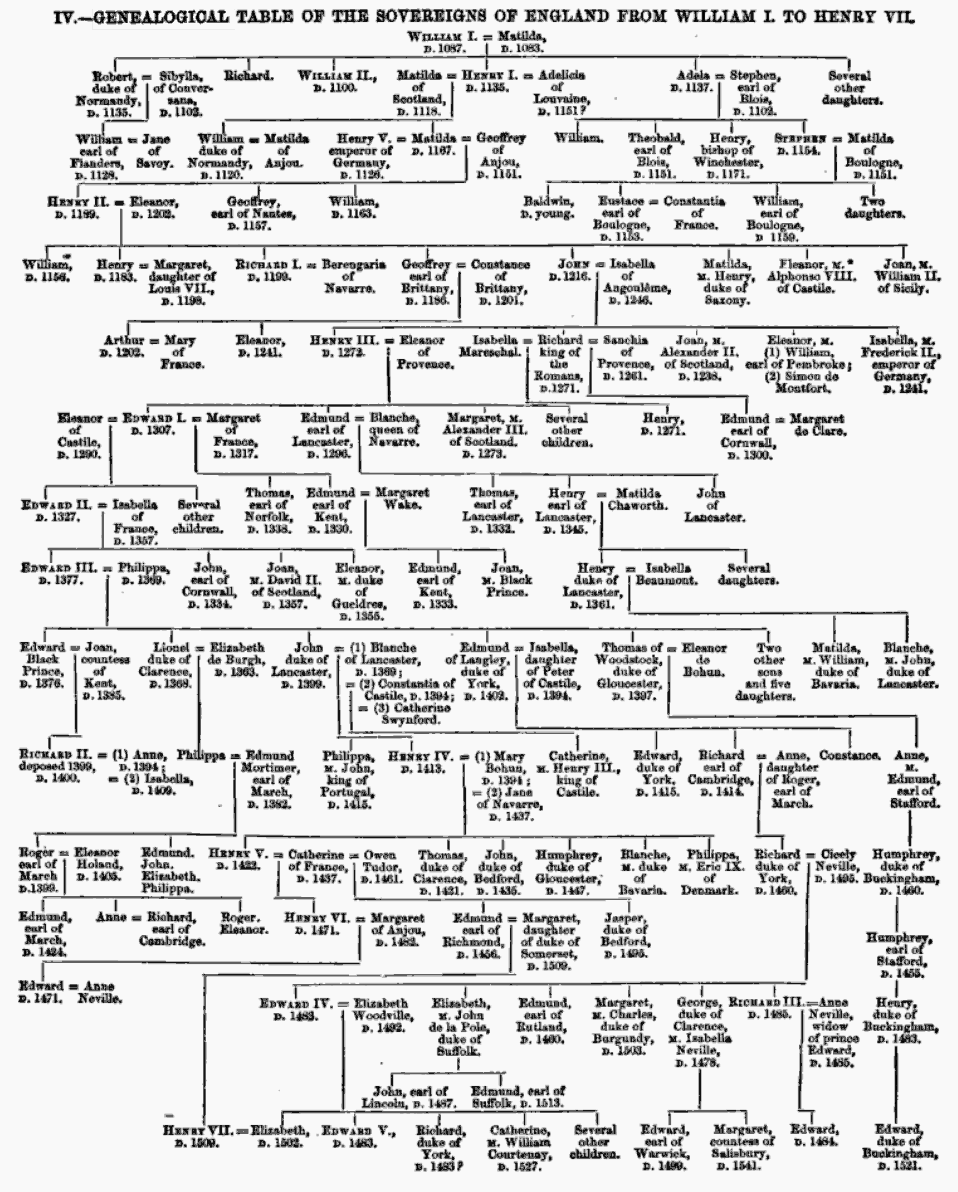
Chart of the English Succession from William I through Henry VII
Medieval English Drama
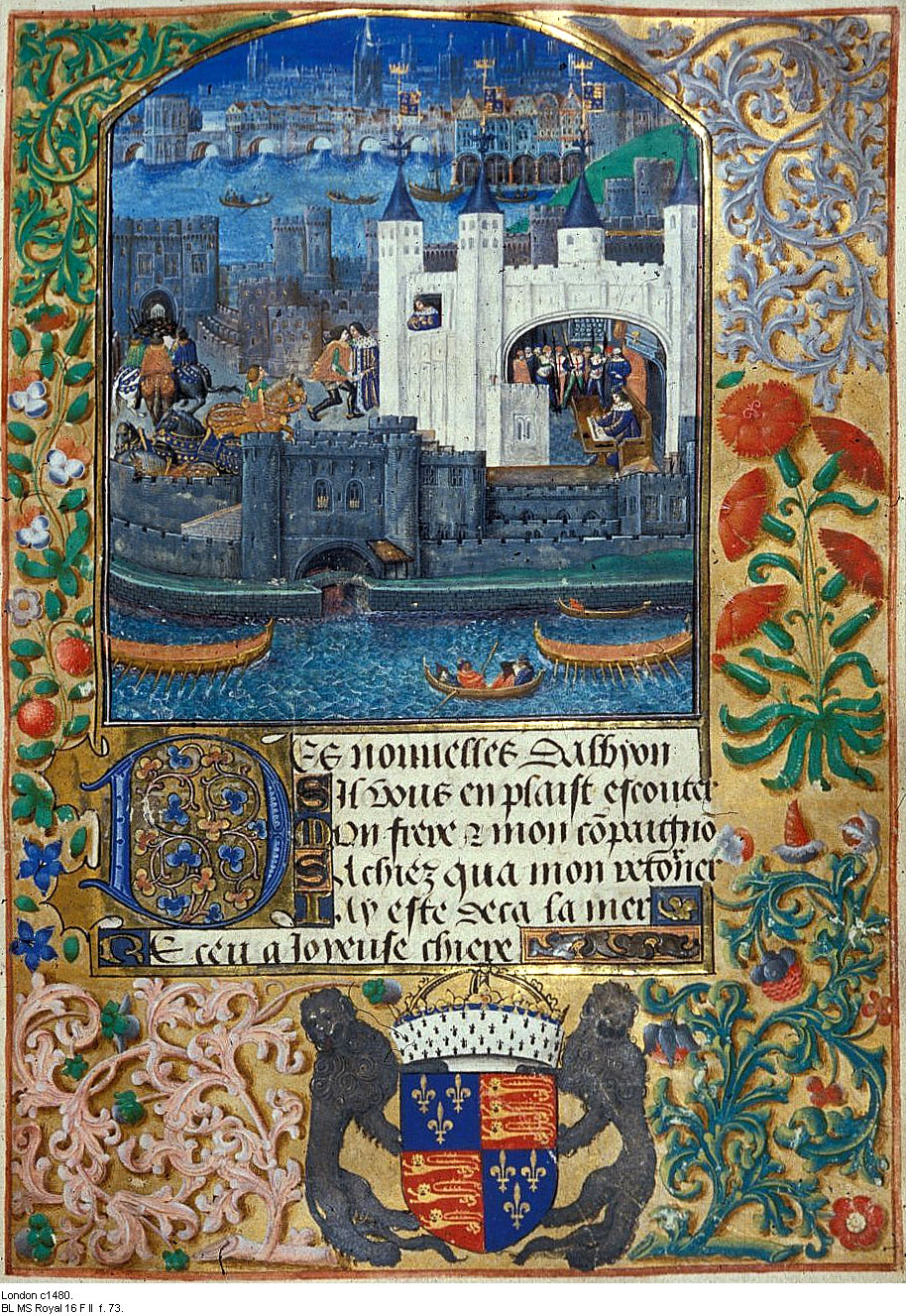
London c1480, MS Royal 16
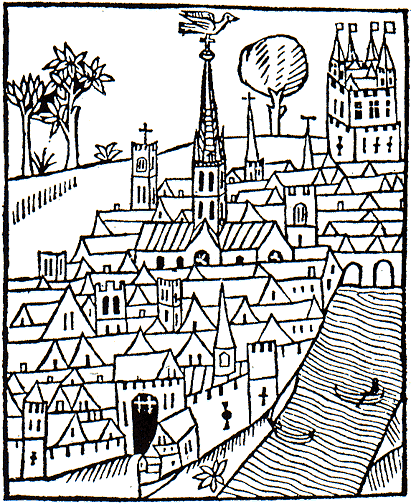
London, 1510, the earliest view in print
Map of England from Saxton's Descriptio Angliae, 1579
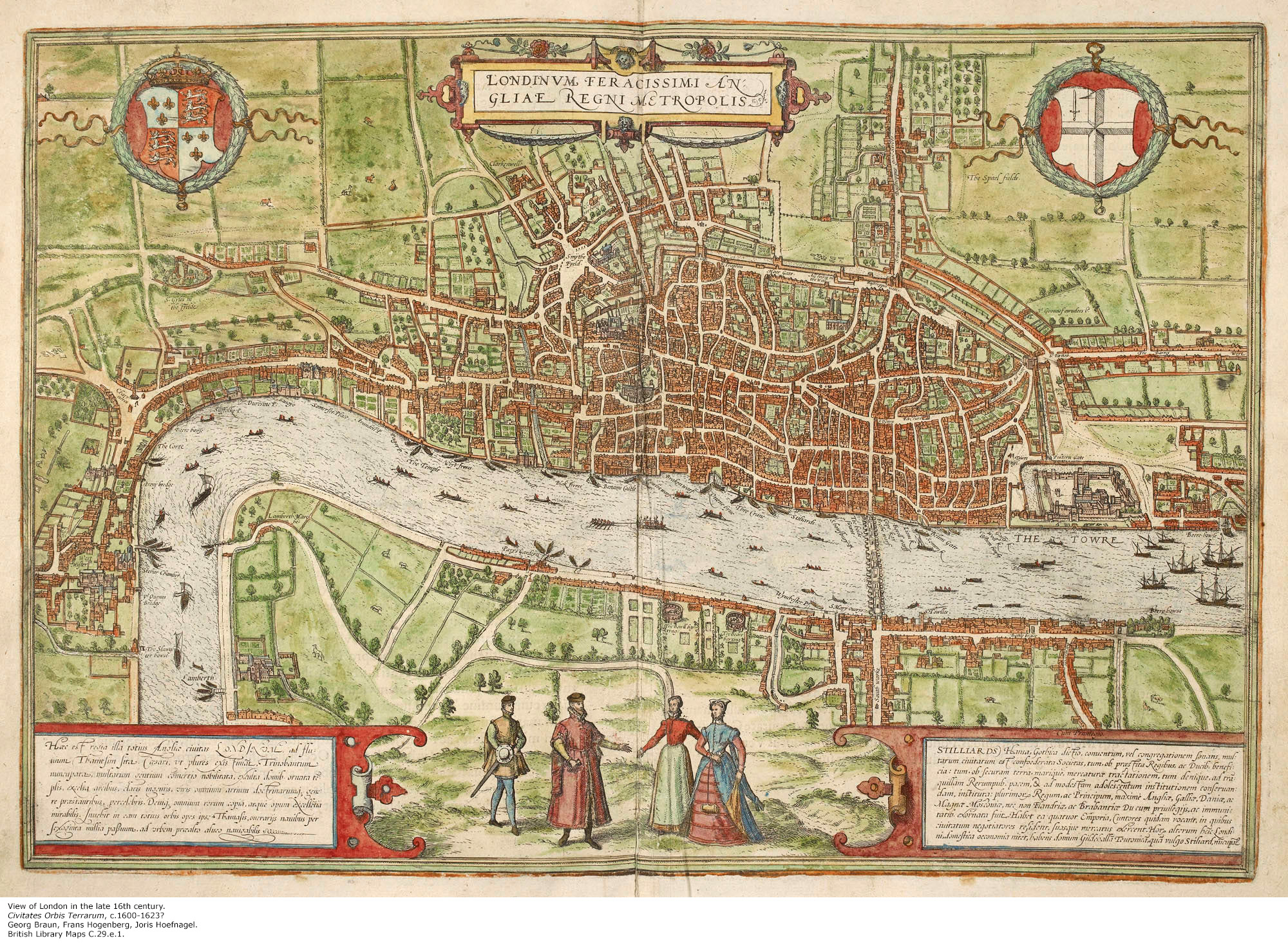
London in late 16th century
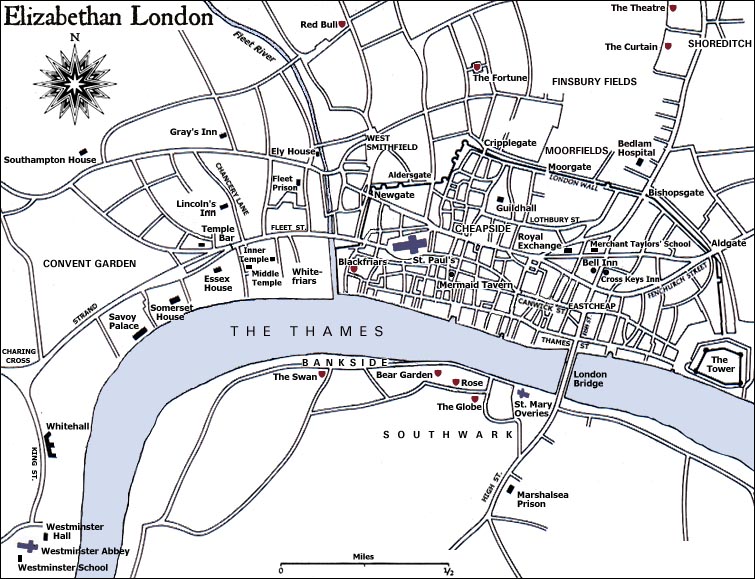
Location Map of Elizabethan London
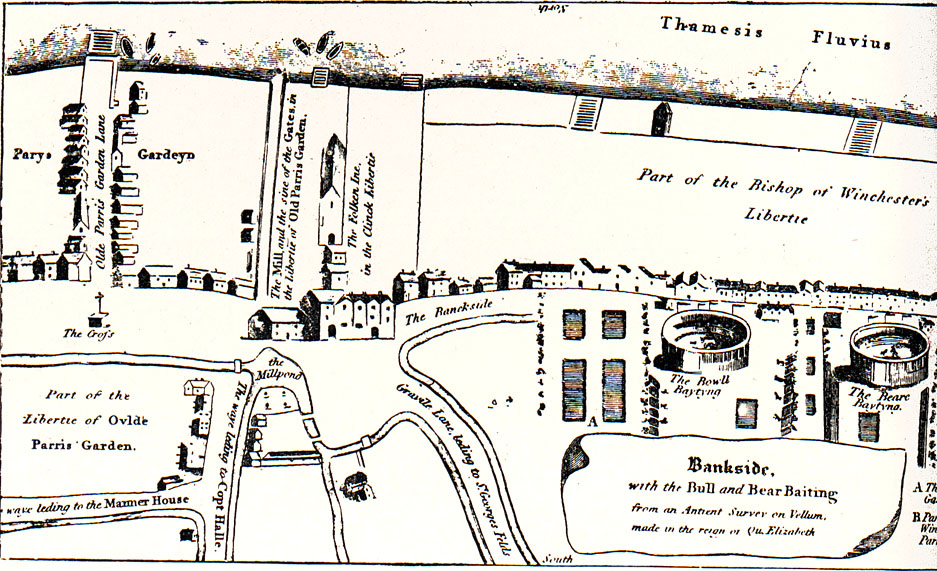
Plan of the Bankside, Southwark, in Shakespeare's time
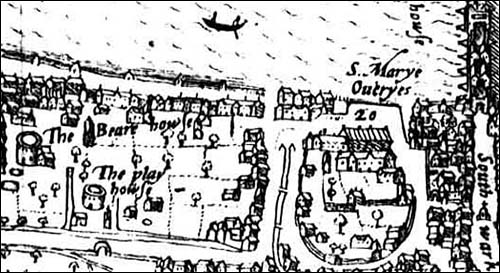
Detail of Norden's Map of the Bankside, 1593
Bull and Bear Baiting Rings from the Agas Map (1569-1590, pub. 1631)
Sketch of the Swan Theatre, c. 1596
Westminster in the Seventeenth Century, by Hollar
Visscher's View of London, 1616
Larger Visscher's View in Sections
c. 1690. View of London Churches, after the Great Fire
The Yard of the Tabard Inn from Thornbury, Old and New London
|
|