|
|
|
|
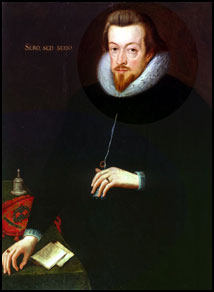
ROBERT CECIL, 1st Earl of Salisbury, English lord treasurer, the exact year of whose birth is unrecorded, was the youngest son
of William Cecil, 1st Lord Burghley, and of his second wife Mildred, daughter of Sir Anthony Cooke, of Gidea
Hall in Essex. He was educated in his father's house and at Cambridge University.
In 1584 he was sent to France, and was returned the same year to parliament, and again in 1586, as member for Westminster. In 1588 he
accompanied Lord Derby in his mission to the Netherlands to negotiate peace with Spain, and sat in the parliament of 1588, and in the
assemblies of 1593, 1597 and 1601 for Hertfordshire. About 1589 he appears to have entered upon the duties of secretary of state, though
he did not receive the official appointment till 1596. On the 20th of May 1591 he was knighted, and in August sworn of the privy council.
In 1597 he was made chancellor of the duchy of Lancaster, and in 1598 despatched on a mission to Henry IV of France, to prevent the
impending alliance between that country and Spain.
The next year he succeeded his father as master of the court of wards. On Lord Burghley's death on the 4th
of August both Essex and Bacon desired to succeed him
in the supreme direction of affairs, but the queen preferred the son of her
last great minister. On Essex's disgrace, consequent on his sudden and unauthorized abandonment of his command in Ireland, Cecil's
conduct was worthy of high praise. "By employing his credit with Her Majesty in behalf of the Earl," wrote John Petit (June 14, 1600),
"he has gained great credit to himself both at home and abroad."
At this period began Cecil's secret correspondence with James in Scotland.
Hitherto Cecil's enemies had persuaded James that the secretary was unfavourable to his claims to the English throne. An understanding
was now effected by which Cecil was able to assure James of his succession, ensure his own power and predominance in the new reign
against Sir Walter Raleigh and other competitors, and secure the tranquillity
of the last years of Elizabeth, the conditions demanded by him being that all
attempts of James to obtain parliamentary recognition of his title should cease, that an absolute respect should be paid to the queen's
feelings, and that the communications should remain a profound secret. Writing later in the reign of James, Cecil says: "If Her Majesty
had known all I did, how well these (? she) should have known the innocency and constancy of my present faith, yet her age and orbity,
joined to the jealousy of her sex, might have moved her to think ill of that which helped to preserve her."1
Such was the nature of these secret communications, which, while they aimed at securing for Cecil a fresh lease of power in the new reign,
conferred undoubted advantages on the country.
Owing to Cecil's action, on the death of Elizabeth on the 24th of March, 1603, James
was proclaimed king, and took possession of the throne without opposition. Cecil was continued in his office, was created Baron Cecil
of Essendon in Rutlandshire on the 13th of May, Viscount Cranborne on the 10th of August 1604, and earl of Salisbury on the 4th of May
1605. He was elected chancellor of the University of Cambridge in February 1601, and obtained the Garter in May 1606. Meanwhile Cecil's
success had completed the discontent of Raleigh, who, exasperated at his
dismissal from the captaincy of the guard, became involved — whether innocently or not is uncertain — in the treasonable
conspiracy known as the "Bye Plot." Cecil took a leading part in his trial in July 1603, and, though probably convinced of his guilt,
endeavoured to ensure him a fair trial and rebuked the attorney-general, Sir Edward Coke, for his harshness towards the prisoner.
On the 6th of May 1608 the office of lord treasurer was added to Salisbury's other appointments, and the whole conduct of public affairs
was placed solely in his hands. His real policy is not always easy to distinguish, for the king constantly interfered, and Cecil, far from
holding any absolute or continuous control, was often not even an adviser but merely a follower, simulating approval of schemes opposed to
his real judgment. In foreign affairs his aim was to preserve the balance of power between France and Spain, and to secure the independence
of the Netherlands from either state. He also hoped, like his father, to make England the head of the Protestant alliance abroad; and his
last energies were expended in effecting the marriage in 1612 of the princess Elizabeth, James's daughter, with the Elector Palatine. He
was in favour of peace, preoccupied with the state of the finances at home and the decreasing revenue, and, though sharing Raleigh's
dislike of Spain, was instrumental in making the treaty with that power in 1604. In June 1607 he promised the support of the government
to the merchants who complained of Spanish ill-usage, but declared that the commons must not meddle with questions of peace and war.
In 1611 he disapproved of the proposed marriage between the prince of Wales and the Infanta. His bias against
Spain and his fidelity to the national interests render, therefore, his acceptance of a pension from Spain a surprising incident in his
career. At the conclusion of the peace in 1604 the sum Cecil received was £1,000, which was raised the following year to £1,500;
while in 1609 he demanded an augmentation and to be paid for each piece of information separately. If, as has been stated,2
he received a pension also from France, it is not improbable that, like his contemporary Bacon,
who accepted presents from suitors on both sides and still gave an independent decree, Cecil may have maintained a freedom from corrupting
influences, while his acceptance of money as the price of information concerning the intentions of the government may have formed part of
a general policy of cultivating good relations with the two great rivals of England (one advantage of which was the communication of plots
formed against the government), and of maintaining the balance of power between them. It is difficult, however, in the absence of complete
information, to understand the exact nature and signification of these strange relations.
As lord treasurer Salisbury showed considerable financial ability. During the year preceding his acceptance of that office the expenditure
had risen to £500,000, leaving, with an ordinary revenue of about £320,000 and the subsidies voted by parliament, a yearly
deficit of £73,000. Lord Salisbury took advantage of the decision by the judges in the court of exchequer in Bates's case in favour
of the king's right to levy impositions; and (on the 28th of July 1608) imposed new duties on articles of luxury and those of foreign
manufacture which competed with English goods, while lowering the dues on currants and tobacco. By this measure, and by a more careful
collection, the ordinary income was raised to £460,000, while £700,000 was paid off the debt, leaving at the beginning of 1610
the sum of £300,000. This was a substantial reform, and if, as has been stated, the "total result of Salisbury's financial administration"
was "the halving of the debt at the cost of doubling the deficiency," the failure to secure a permanent improvement must be ascribed to
the extravagance of James, who, disregarding his minister's entreaties and advice, continued to exceed his income by £149,000.
But a want of statesmanship had been shown by Salisbury in forcing the king's legal right to levy impositions against the remonstrances
of the parliament. In the "great contract," the scheme now put forward by Salisbury for settling the finances, his lack of political
wisdom was still more apparent. The Commons were to guarantee a fixed annual subsidy, on condition of the abandonment of impositions and
of the redress of grievances by the king. An unworthy and undignified system of higgling and haggling was initiated between the crown and
the parliament. Salisbury could only attribute the miscarriage of his scheme to the fact "that God did not bless it." But Bacon regarded
it with severe disapproval, and in the parliament of 1613, after the treasurer's death, he begged the king to abandon these humiliating
and dangerous bargainings, "that your majesty do for this parliament put off the person of a merchant and contractor and rest upon the
person of a king."3 In fact, the vicious principle was introduced that a redress of grievances could
only be obtained by a payment of subsidies. The identity of interests between the crown and the nation which had made the reign of Elizabeth
so glorious, and which she herself had consummated on the occasion of her last public appearance by a free and voluntary concession of
these same impositions, was now destroyed, and a divergence of interests, made patent by vulgar bargaining, was substituted which stimulated
the disastrous struggle between sovereign and people, and paralysed the national development for two generations.
This was scarcely a time to expect any favours for the Roman Catholics, but Salisbury, while fearing that the Roman Church in England would
become a danger to the state, had always been averse from prosecution for religion, and he attempted to distinguish between the large body
of law-abiding and loyal Roman Catholics and those connected with plots and intrigues against the throne and government, making the offer
in October 1607 that if the pope would excommunicate those that rebelled against the king and oblige them to defend him against invasion,
the fines for recusancy would be remitted and they would be allowed to keep priests in their houses. This was a fair measure of toleration.
His want of true statesmanship was shown with regard to the Protestant Nonconformists, towards whom his attitude was identical with that
afterwards maintained by Laud, and the same ideal pursued, namely that of material and outward conformity, Salisbury
employing almost the same words as the archbishop later, that "unity in belief cannot be preserved unless it is to be found in worship."4
Bacon's disparaging estimate of his cousin and rival was probably tinged with some personal animus, and instigated by the hope of recommending
himself to James as his successor; but there is little doubt that his acute and penetrating description of Salisbury to James as one "fit to
prevent things from growing worse but not fit to make them better," as one "greater in operatione than in opere," is a true one.
Elsewhere Bacon accuses him "of an artificial animating of the negative"5 — in modern language,
of official obstruction and "red tape." But in one instance at least, when he advised James not to press forward too hastily the union of
England and Scotland, a measure which especially appealed to Bacon's imagination and was ardently desired by him, Salisbury showed a
prudence and judgment superior to his illustrious critic.
It can scarcely be denied that he rendered substantial services to the state in times of great difficulty and perplexity, and these services
would probably have been greater and more permanent had he served a better king and in more propitious times. Both Elizabeth and James found
a security in Salisbury's calm good sense, safe, orderly official mind and practical experience of business, of which there was no guarantee
in the restlessness of Essex, the enterprise of Raleigh or the speculation of Bacon. On the other hand, he was neither guided nor inspired
by any great principle or ideal, he contributed nothing towards the settlement of the great national problems, and he precipitated by his
ill-advised action the disastrous struggle between crown and parliament.
Lord Salisbury died on the 24th of May 1612, at the parsonage house at Marlborough, while returning to London from taking the waters at Bath.
During his long political career he had amassed a large fortune, besides inheriting a considerable portion of Lord Burghley's landed estate.
In 1607 he exchanged, at the king's request, his estate of Theobalds in Hertfordshire for Hatfield. Here he
built the magnificent house of which he himself conceived the plans and the design, but which he did not live to inhabit, its completion
almost coinciding with his death. In person and figure he was in strange contrast with his rivals at court, being diminutive in stature,
ill-formed and weak in health. Elizabeth styled him her pygmy; his enemies delighted in vilifying his "wry neck," "crooked back" and "splay
foot," and in Bacon's essay " On Deformity," it was said, "the world takes notice
that he paints out his little cousin to the life."6 Molin, the Venetian ambassador in England, gives
a similar description of his person, but adds that he had "a noble countenance and features."7
Lord Salisbury wrote The State and Dignitie of a Secretaire of Estate's Place (publ. 1642, reprinted in Harleian Miscellany, ii.
and Somers Tracts (1809), v.; see also Harleian MSS. 305 and 354), and An Answer to Certain Scandalous Papers scattered abroad under
Colour of a Catholick Admonition (1606), justifying his attitude towards recusants after the discovery of the
Gunpowder Plot (Harl. Misc. ii.; Somers Tracts, v.). He married Elizabeth, daughter of William
Brooke, 5th Baron Cobham, by whom, besides one daughter, he had William (1591-1668), his successor as 2nd earl.
1 Correspondence of King James VI. of Scotland with Sir R. Cecil,
ed. by J. Bruce (Camden Soc., 1861), p. xl.
2 Gardiner, History of England, i. 224.
3 Spedding, Life and Letters of Bacon, iv. 276.
4 Gardiner, History of England, i. 199.
5 Spedding, Life and Letters of Bacon, iv. 278 note, 279.
6 Chamberlain to Carleton, Birch's Court of King James, i. 214.
7 Cal. of State Papers: Venetian, x. 515.
Excerpted from:
Encyclopedia Britannica, 11th Ed. Vol III.
Cambridge: Cambridge University Press, 1910. 96.
Other Local Resources:
Books for further study:
Cecil, Algernon. A Life of Robert Cecil, First Earl of Salisbury.
Greenwood Press, 1971.
Fraser, Antonia. Faith and Treason: The Story of the Gunpowder Plot.
Anchor Books, 1997.
Handover, P.M. The Second Cecil: The Rise to Power, 1563-1604,
of Sir Robert Cecil, Late First Earl of Salisbury.
Eyre & Spottiswoode, 1959.
Haynes, Alan. Robert Cecil: Earl of Salisbury, 1563-1612:
Servant of Two Sovereigns.
Peter Owen Publishers, 1989.
Loades, David. The Cecils: Privilege and Power Behind the Throne.
London: Bloomsbury Academic, 2009.
Nicolson, Adam. God's Secretaries: The Making of the King James Bible.
New York: Harper Collins, 2003.
Sutton, James M. Materializing Space at an Early Modern Prodigy House:
The Cecils at Theobalds, 1564-1607.
Hampshire, England: Ashgate Publishing, 2004.
Robert Cecil on the Web:
 | to Elizabeth I |
| to King James I |
| to Renaissance English Literature |
| to Luminarium Encyclopedia |
|
Index of Encyclopedia Entries:
Medieval Cosmology
Prices of Items in Medieval England
Edward II
Isabella of France, Queen of England
Piers Gaveston
Thomas of Brotherton, E. of Norfolk
Edmund of Woodstock, E. of Kent
Thomas, Earl of Lancaster
Henry of Lancaster, Earl of Lancaster
Henry of Grosmont, Duke of Lancaster
Roger Mortimer, Earl of March
Hugh le Despenser the Younger
Bartholomew, Lord Burghersh, elder
Hundred Years' War (1337-1453)
Edward III
Philippa of Hainault, Queen of England
Edward, Black Prince of Wales
John of Eltham, Earl of Cornwall
The Battle of Crécy, 1346
The Siege of Calais, 1346-7
The Battle of Poitiers, 1356
Lionel of Antwerp, Duke of Clarence
John of Gaunt, Duke of Lancaster
Edmund of Langley, Duke of York
Thomas of Woodstock, Gloucester
Richard of York, E. of Cambridge
Richard Fitzalan, 3. Earl of Arundel
Roger Mortimer, 2nd Earl of March
The Good Parliament, 1376
Richard II
The Peasants' Revolt, 1381
Lords Appellant, 1388
Richard Fitzalan, 4. Earl of Arundel
Archbishop Thomas Arundel
Thomas de Beauchamp, E. Warwick
Robert de Vere, Earl of Oxford
Ralph Neville, E. of Westmorland
Thomas Mowbray, Duke of Norfolk
Edmund Mortimer, 3. Earl of March
Roger Mortimer, 4. Earl of March
John Holland, Duke of Exeter
Michael de la Pole, E. Suffolk
Hugh de Stafford, 2. E. Stafford
Henry IV
Edward, Duke of York
Edmund Mortimer, 5. Earl of March
Henry Percy, Earl of Northumberland
Sir Henry Percy, "Harry Hotspur"
Thomas Percy, Earl of Worcester
Owen Glendower
The Battle of Shrewsbury, 1403
Archbishop Richard Scrope
Thomas Mowbray, 3. E. Nottingham
John Mowbray, 2. Duke of Norfolk
Thomas Fitzalan, 5. Earl of Arundel
Henry V
Thomas, Duke of Clarence
John, Duke of Bedford
Humphrey, Duke of Gloucester
John Talbot, Earl of Shrewsbury
Richard, Earl of Cambridge
Henry, Baron Scrope of Masham
William de la Pole, Duke of Suffolk
Thomas Montacute, E. Salisbury
Richard Beauchamp, E. of Warwick
Henry Beauchamp, Duke of Warwick
Thomas Beaufort, Duke of Exeter
Cardinal Henry Beaufort
John Beaufort, Earl of Somerset
Sir John Fastolf
John Holland, 2. Duke of Exeter
Archbishop John Stafford
Archbishop John Kemp
Catherine of Valois
Owen Tudor
John Fitzalan, 7. Earl of Arundel
John, Lord Tiptoft
Charles VII, King of France
Joan of Arc
Louis XI, King of France
Charles the Bold, Duke of Burgundy
The Battle of Agincourt, 1415
The Battle of Castillon, 1453
The Wars of the Roses 1455-1485
Causes of the Wars of the Roses
The House of Lancaster
The House of York
The House of Beaufort
The House of Neville
The First Battle of St. Albans, 1455
The Battle of Blore Heath, 1459
The Rout of Ludford, 1459
The Battle of Northampton, 1460
The Battle of Wakefield, 1460
The Battle of Mortimer's Cross, 1461
The 2nd Battle of St. Albans, 1461
The Battle of Towton, 1461
The Battle of Hedgeley Moor, 1464
The Battle of Hexham, 1464
The Battle of Edgecote, 1469
The Battle of Losecoat Field, 1470
The Battle of Barnet, 1471
The Battle of Tewkesbury, 1471
The Treaty of Pecquigny, 1475
The Battle of Bosworth Field, 1485
The Battle of Stoke Field, 1487
Henry VI
Margaret of Anjou
Richard Plantagenet, Duke of York
Edward IV
Elizabeth Woodville
Richard Woodville, 1. Earl Rivers
Anthony Woodville, 2. Earl Rivers
Jane Shore
Edward V
Richard III
George, Duke of Clarence
Ralph Neville, 2. Earl of Westmorland
Richard Neville, Earl of Salisbury
Richard Neville, Earl of Warwick
Edward Neville, Baron Bergavenny
William Neville, Lord Fauconberg
Robert Neville, Bishop of Salisbury
John Neville, Marquis of Montagu
George Neville, Archbishop of York
John Beaufort, 1. Duke Somerset
Edmund Beaufort, 2. Duke Somerset
Henry Beaufort, 3. Duke of Somerset
Edmund Beaufort, 4. Duke Somerset
Margaret Beaufort
Edmund Tudor, Earl of Richmond
Jasper Tudor, Earl of Pembroke
Humphrey Stafford, D. Buckingham
Henry Stafford, Duke of Buckingham
Humphrey Stafford, E. of Devon
Thomas, Lord Stanley, Earl of Derby
Sir William Stanley
Archbishop Thomas Bourchier
Henry Bourchier, Earl of Essex
John Mowbray, 3. Duke of Norfolk
John Mowbray, 4. Duke of Norfolk
John Howard, Duke of Norfolk
Henry Percy, 2. E. Northumberland
Henry Percy, 3. E. Northumberland
Henry Percy, 4. E. Northumberland
William, Lord Hastings
Henry Holland, Duke of Exeter
William Fitzalan, Earl of Arundel
William Herbert, 1. Earl of Pembroke
John de Vere, 12th Earl of Oxford
John de Vere, 13th Earl of Oxford
Thomas de Clifford, 8. Baron Clifford
John de Clifford, 9. Baron Clifford
John Tiptoft, Earl of Worcester
Thomas Grey, 1. Marquis Dorset
Sir Andrew Trollop
Archbishop John Morton
Edward Plantagenet, E. of Warwick
John Talbot, 2. E. Shrewsbury
John Talbot, 3. E. Shrewsbury
John de la Pole, 2. Duke of Suffolk
John de la Pole, E. of Lincoln
Edmund de la Pole, E. of Suffolk
Richard de la Pole
John Sutton, Baron Dudley
James Butler, 5. Earl of Ormonde
Sir James Tyrell
Edmund Grey, first Earl of Kent
George Grey, 2nd Earl of Kent
John, 5th Baron Scrope of Bolton
James Touchet, 7th Baron Audley
Walter Blount, Lord Mountjoy
Robert Hungerford, Lord Moleyns
Thomas, Lord Scales
John, Lord Lovel and Holand
Francis Lovell, Viscount Lovell
Sir Richard Ratcliffe
William Catesby
Ralph, 4th Lord Cromwell
Jack Cade's Rebellion, 1450
Tudor Period
King Henry VII
Queen Elizabeth of York
Arthur, Prince of Wales
Lambert Simnel
Perkin Warbeck
The Battle of Blackheath, 1497
King Ferdinand II of Aragon
Queen Isabella of Castile
Maximilian I, Holy Roman Emperor
King Henry VIII
Queen Catherine of Aragon
Queen Anne Boleyn
Queen Jane Seymour
Queen Anne of Cleves
Queen Catherine Howard
Queen Katherine Parr
King Edward VI
Queen Mary I
Queen Elizabeth I
Henry Fitzroy, Duke of Richmond
Margaret Tudor, Queen of Scotland
James IV, King of Scotland
The Battle of Flodden Field, 1513
James V, King of Scotland
Mary of Guise, Queen of Scotland
Mary Tudor, Queen of France
Louis XII, King of France
Francis I, King of France
The Battle of the Spurs, 1513
Field of the Cloth of Gold, 1520
Charles V, Holy Roman Emperor
Eustace Chapuys, Imperial Ambassador
The Siege of Boulogne, 1544
Cardinal Thomas Wolsey
Archbishop Thomas Cranmer
Thomas Cromwell, Earl of Essex
Thomas, Lord Audley
Thomas Wriothesley, E. Southampton
Sir Richard Rich
Edward Stafford, D. of Buckingham
Thomas Howard, 2nd Duke of Norfolk
Thomas Howard, 3rd Duke of Norfolk
John Dudley, Duke of Northumberland
Charles Brandon, Duke of Suffolk
Thomas Boleyn, Earl of Wiltshire
George Boleyn, Viscount Rochford
John Russell, Earl of Bedford
Thomas Grey, 2. Marquis of Dorset
Henry Grey, D. of Suffolk
Charles Somerset, Earl of Worcester
George Talbot, 4. E. Shrewsbury
Francis Talbot, 5. E. Shrewsbury
Henry Algernon Percy,
5th Earl of Northumberland
Henry Algernon Percy,
6th Earl of Northumberland
Ralph Neville, 4. E. Westmorland
Henry Neville, 5. E. Westmorland
William Paulet, Marquis of Winchester
Sir Francis Bryan
Sir Nicholas Carew
John de Vere, 15th Earl of Oxford
John de Vere, 16th Earl of Oxford
Thomas Seymour, Lord Admiral
Edward Seymour, Protector Somerset
Margaret Pole, Countess of Salisbury
Henry Pole, Lord Montague
Sir Geoffrey Pole
Thomas Manners, Earl of Rutland
Henry Manners, Earl of Rutland
Henry Bourchier, 2. Earl of Essex
Robert Radcliffe, 1. Earl of Sussex
Henry Radcliffe, 2. Earl of Sussex
George Hastings, Earl of Huntingdon
Henry Courtenay, Marquis of Exeter
George Neville, Baron Bergavenny
Sir Edward Neville
William, Lord Paget
William Sandys, Baron Sandys
William Fitzwilliam, E. Southampton
Sir Anthony Browne
Sir Thomas Wriothesley
Sir William Kingston
George Brooke, Lord Cobham
Sir Richard Southwell
Thomas Fiennes, 9th Lord Dacre
Sir Francis Weston
Henry Norris
Lady Jane Grey
Sir Thomas Arundel
Sir Richard Sackville
Sir William Petre
Sir John Cheke
Walter Haddon, L.L.D
Sir Peter Carew
Sir John Mason
Nicholas Wotton
John Taylor
Sir Thomas Wyatt, the Younger
Cardinal Lorenzo Campeggio
Cardinal Reginald Pole
Stephen Gardiner, Bishop of Winchester
Edmund Bonner, Bishop of London
Nicholas Ridley, Bishop of London
John Hooper, Bishop of Gloucester
John Aylmer, Bishop of London
Thomas Linacre
William Grocyn
Archbishop William Warham
Cuthbert Tunstall, Bishop of Durham
Richard Fox, Bishop of Winchester
Edward Fox, Bishop of Hereford
Pope Julius II
Pope Leo X
Pope Clement VII
Pope Paul III
Pope Pius V
Pico della Mirandola
Desiderius Erasmus
Martin Bucer
Richard Pace
Christopher Saint-German
Thomas Tallis
Elizabeth Barton, the Nun of Kent
Hans Holbein, the Younger
The Sweating Sickness
Dissolution of the Monasteries
Pilgrimage of Grace, 1536
Robert Aske
Anne Askew
Lord Thomas Darcy
Sir Robert Constable
Oath of Supremacy
The Act of Supremacy, 1534
The First Act of Succession, 1534
The Third Act of Succession, 1544
The Ten Articles, 1536
The Six Articles, 1539
The Second Statute of Repeal, 1555
The Act of Supremacy, 1559
Articles Touching Preachers, 1583
Queen Elizabeth I
William Cecil, Lord Burghley
Robert Cecil, 1st Earl of Salisbury
Sir Francis Walsingham
Sir Nicholas Bacon
Sir Thomas Bromley
Robert Dudley, Earl of Leicester
Ambrose Dudley, Earl of Warwick
Henry Carey, Lord Hunsdon
Sir Thomas Egerton, Viscount Brackley
Sir Francis Knollys
Katherine "Kat" Ashley
Lettice Knollys, Countess of Leicester
George Talbot, 6. E. of Shrewsbury
Elizabeth, Countess of Shrewsbury
Gilbert Talbot, 7. E. of Shrewsbury
Sir Henry Sidney
Sir Robert Sidney
Archbishop Matthew Parker
Walter Devereux, 1st Earl of Essex
Robert Devereux, 2nd Earl of Essex
Penelope Devereux, Lady Rich
Sir Christopher Hatton
Edward Courtenay, E. Devonshire
Edward Manners, 3rd Earl of Rutland
Thomas Radcliffe, 3. Earl of Sussex
Henry Radcliffe, 4. Earl of Sussex
Robert Radcliffe, 5. Earl of Sussex
William Parr, Marquis of Northampton
Henry Wriothesley, 2. Southampton
Henry Wriothesley, 3. Southampton
Charles Neville, 6. E. Westmorland
Thomas Percy, 7. E. Northumberland
Henry Percy, 8. E. Northumberland
Henry Percy, 9. E. Nothumberland
William Herbert, 1. Earl of Pembroke
Charles, Lord Howard of Effingham
Thomas Howard, 4th Duke of Norfolk
Henry Howard, 1. Earl of Northampton
Thomas Howard, 1. Earl of Suffolk
Henry Hastings, 3. E. of Huntingdon
Edward Manners, 3rd Earl of Rutland
Roger Manners, 5th Earl of Rutland
Francis Manners, 6th Earl of Rutland
Henry FitzAlan, 12. Earl of Arundel
Thomas, Earl Arundell of Wardour
Edward Somerset, E. of Worcester
William Davison
Sir Walter Mildmay
Sir Ralph Sadler
Sir Amyas Paulet
Gilbert Gifford
Anthony Browne, Viscount Montague
François, Duke of Alençon & Anjou
Mary, Queen of Scots
Henry Stuart, Lord Darnley
James Hepburn, Earl of Bothwell
Anthony Babington and the Babington Plot
John Knox
Philip II of Spain
The Spanish Armada, 1588
Sir Francis Drake
Sir John Hawkins
William Camden
Archbishop Whitgift
Martin Marprelate Controversy
John Penry (Martin Marprelate)
Richard Bancroft, Archbishop of Canterbury
John Dee, Alchemist
Philip Henslowe
Edward Alleyn
The Blackfriars Theatre
The Fortune Theatre
The Rose Theatre
The Swan Theatre
Children's Companies
The Admiral's Men
The Lord Chamberlain's Men
Citizen Comedy
The Isle of Dogs, 1597
Common Law
Court of Common Pleas
Court of King's Bench
Court of Star Chamber
Council of the North
Fleet Prison
Assize
Attainder
First Fruits & Tenths
Livery and Maintenance
Oyer and terminer
Praemunire
The Stuarts
King James I of England
Anne of Denmark
Henry, Prince of Wales
The Gunpowder Plot, 1605
George Villiers, 1st Duke of Buckingham
Robert Carr, Earl of Somerset
Arabella Stuart, Lady Lennox
William Alabaster
Bishop Hall
Bishop Thomas Morton
Archbishop William Laud
John Selden
Lucy Harington, Countess of Bedford
Henry Lawes
King Charles I
Queen Henrietta Maria
Long Parliament
Rump Parliament
Kentish Petition, 1642
Thomas Wentworth, Earl of Strafford
John Digby, Earl of Bristol
George Digby, 2nd Earl of Bristol
Thomas Fairfax, 3rd Lord Fairfax
Robert Devereux, 3rd E. of Essex
Robert Sidney, 2. E. of Leicester
Algernon Percy, E. of Northumberland
Henry Montagu, Earl of Manchester
Edward Montagu, 2. Earl of Manchester
The Restoration
King Charles II
King James II
Test Acts
Greenwich Palace
Hatfield House
Richmond Palace
Windsor Palace
Woodstock Manor
The Cinque Ports
Mermaid Tavern
Malmsey Wine
Great Fire of London, 1666
Merchant Taylors' School
Westminster School
The Sanctuary at Westminster
"Sanctuary"
Images:
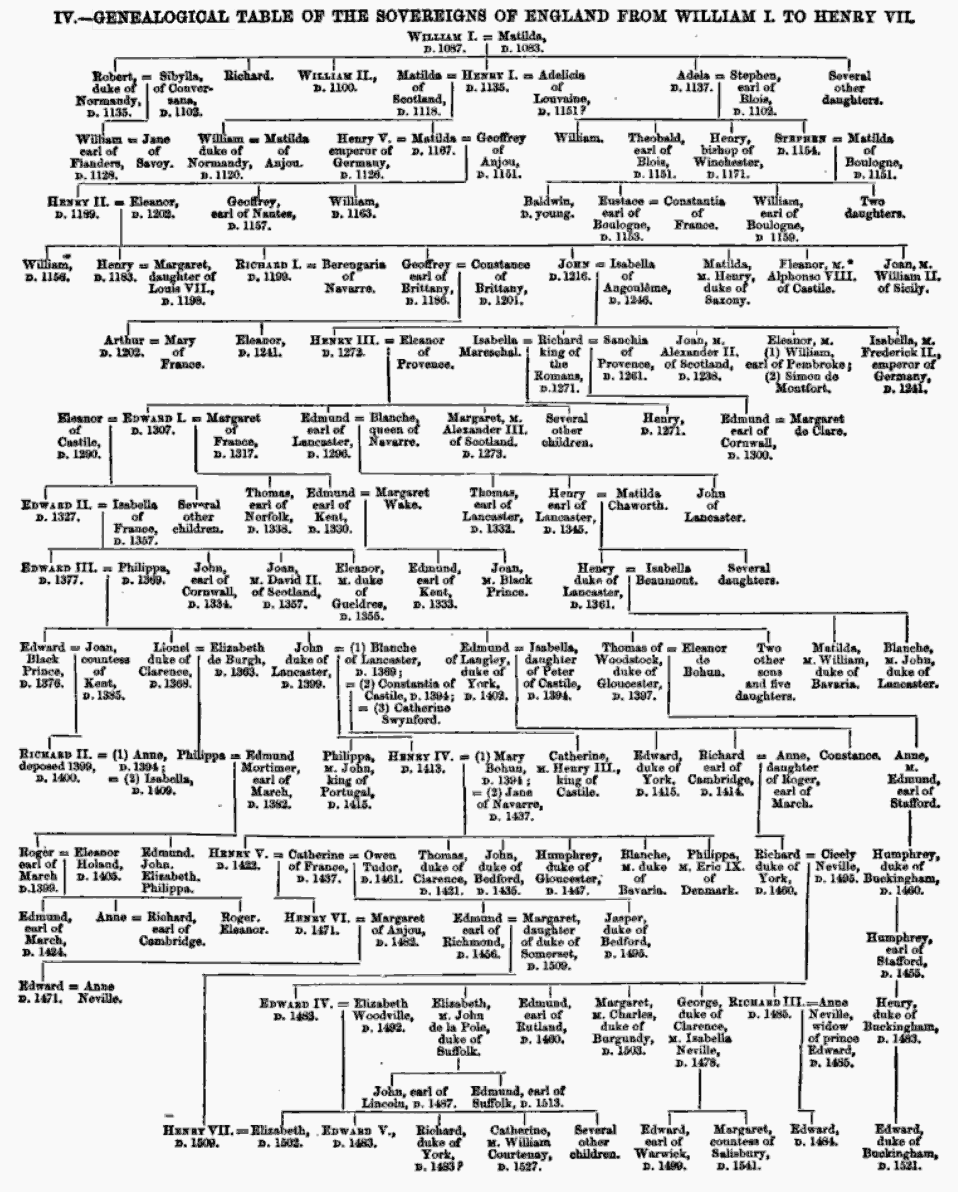
Chart of the English Succession from William I through Henry VII
Medieval English Drama
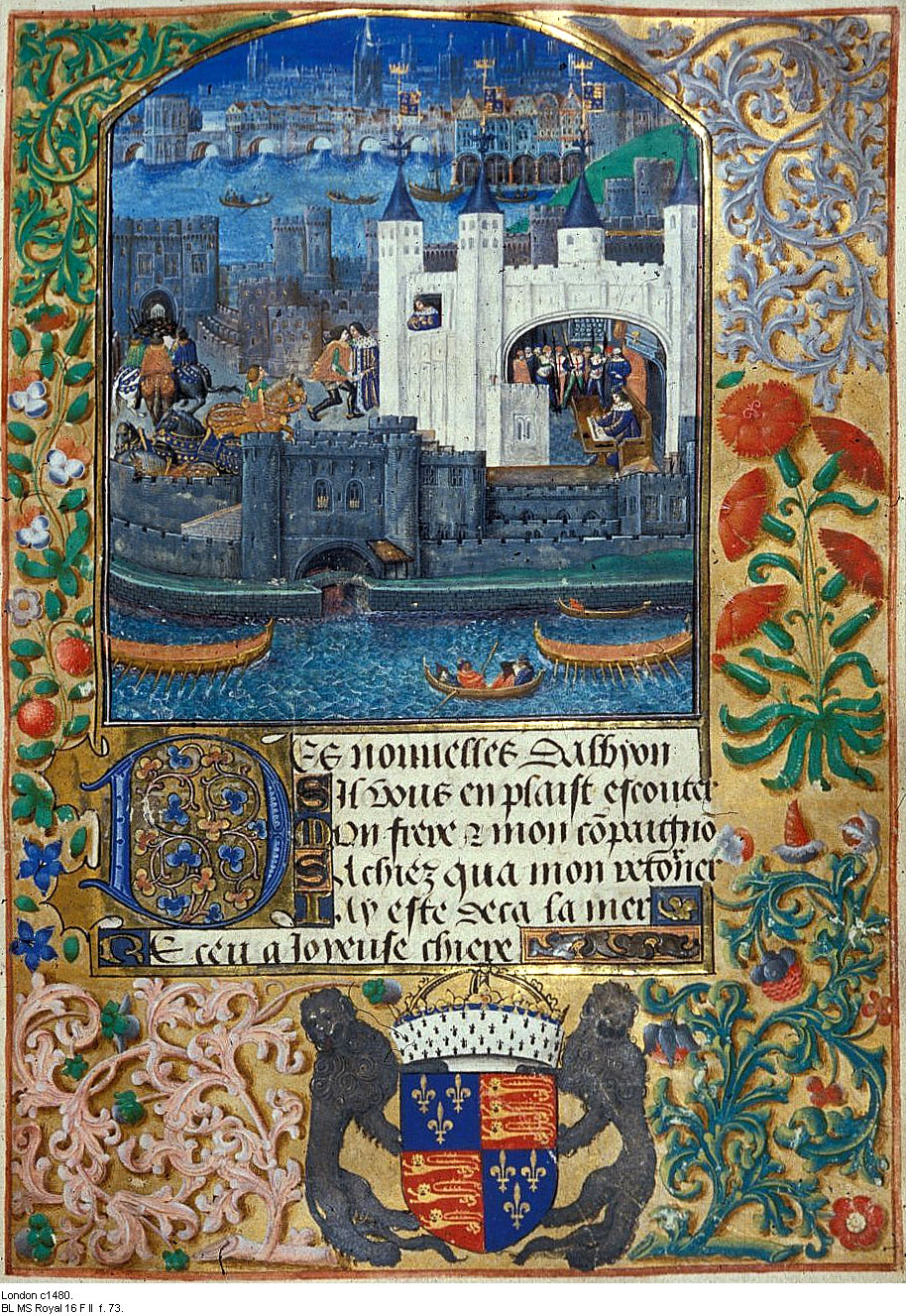
London c1480, MS Royal 16
London, 1510, the earliest view in print
Map of England from Saxton's Descriptio Angliae, 1579
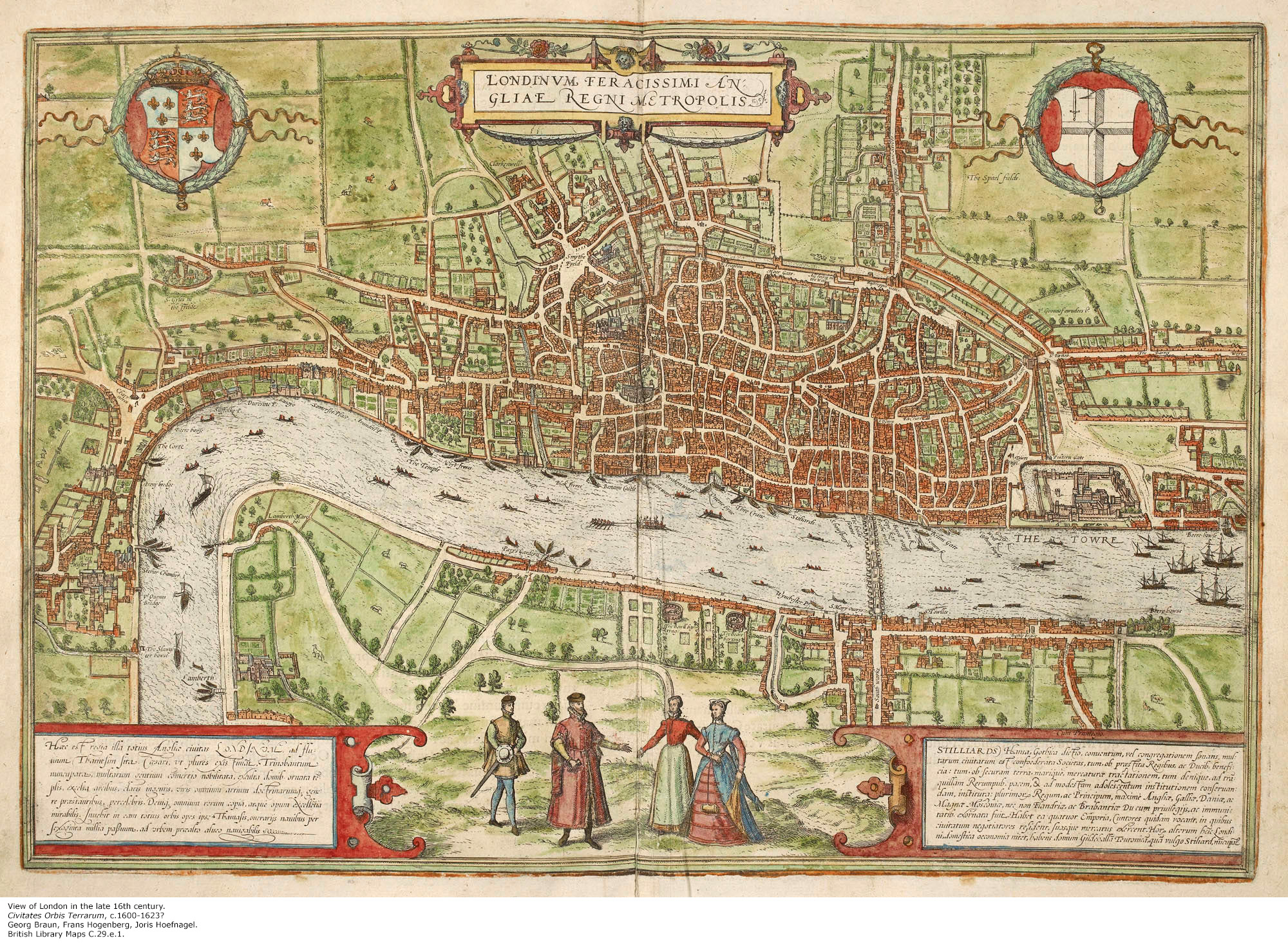
London in late 16th century
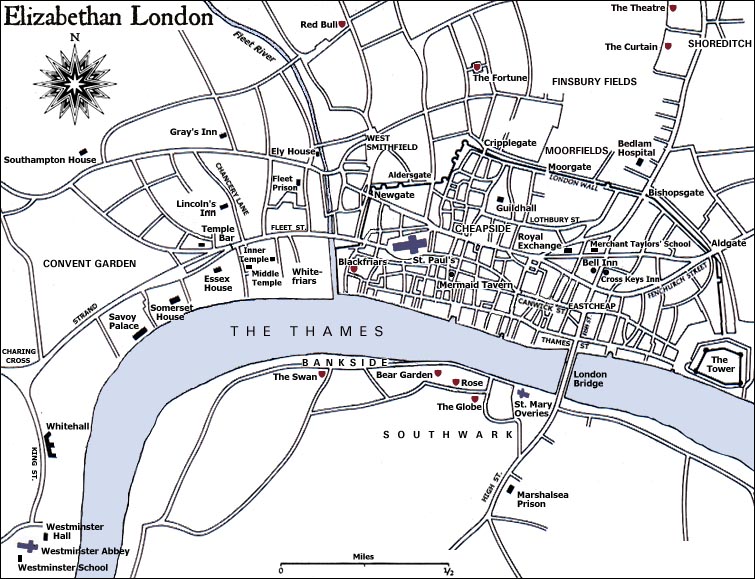
Location Map of Elizabethan London
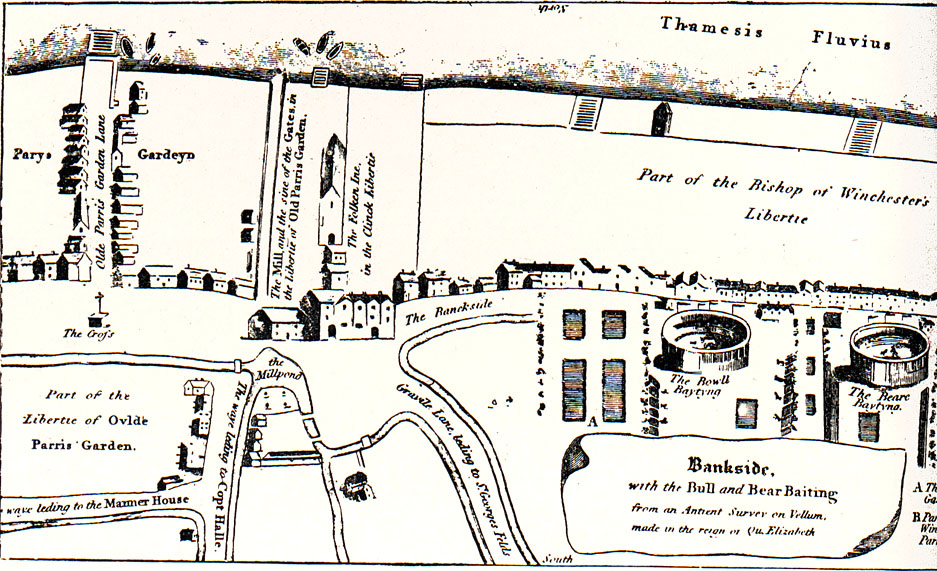
Plan of the Bankside, Southwark, in Shakespeare's time
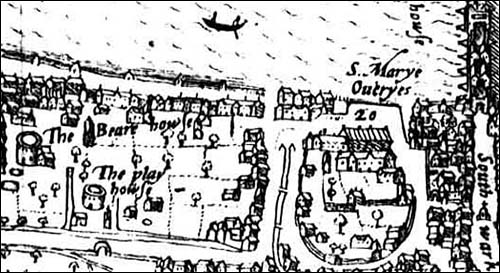
Detail of Norden's Map of the Bankside, 1593
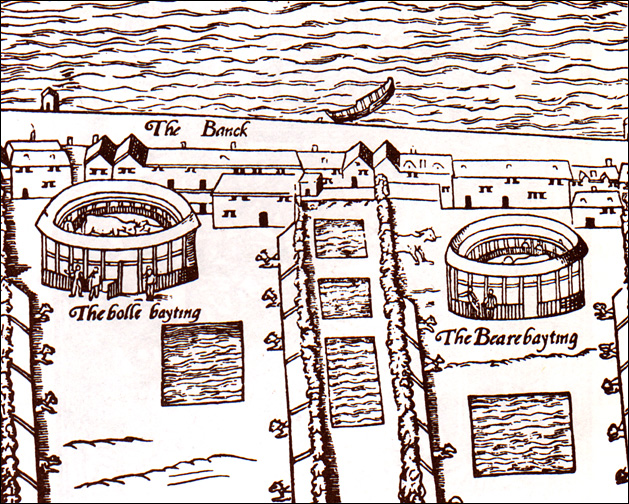
Bull and Bear Baiting Rings from the Agas Map (1569-1590, pub. 1631)
Sketch of the Swan Theatre, c. 1596
Westminster in the Seventeenth Century, by Hollar
Visscher's View of London, 1616
Larger Visscher's View in Sections
c. 1690. View of London Churches, after the Great Fire
The Yard of the Tabard Inn from Thornbury, Old and New London
|
|